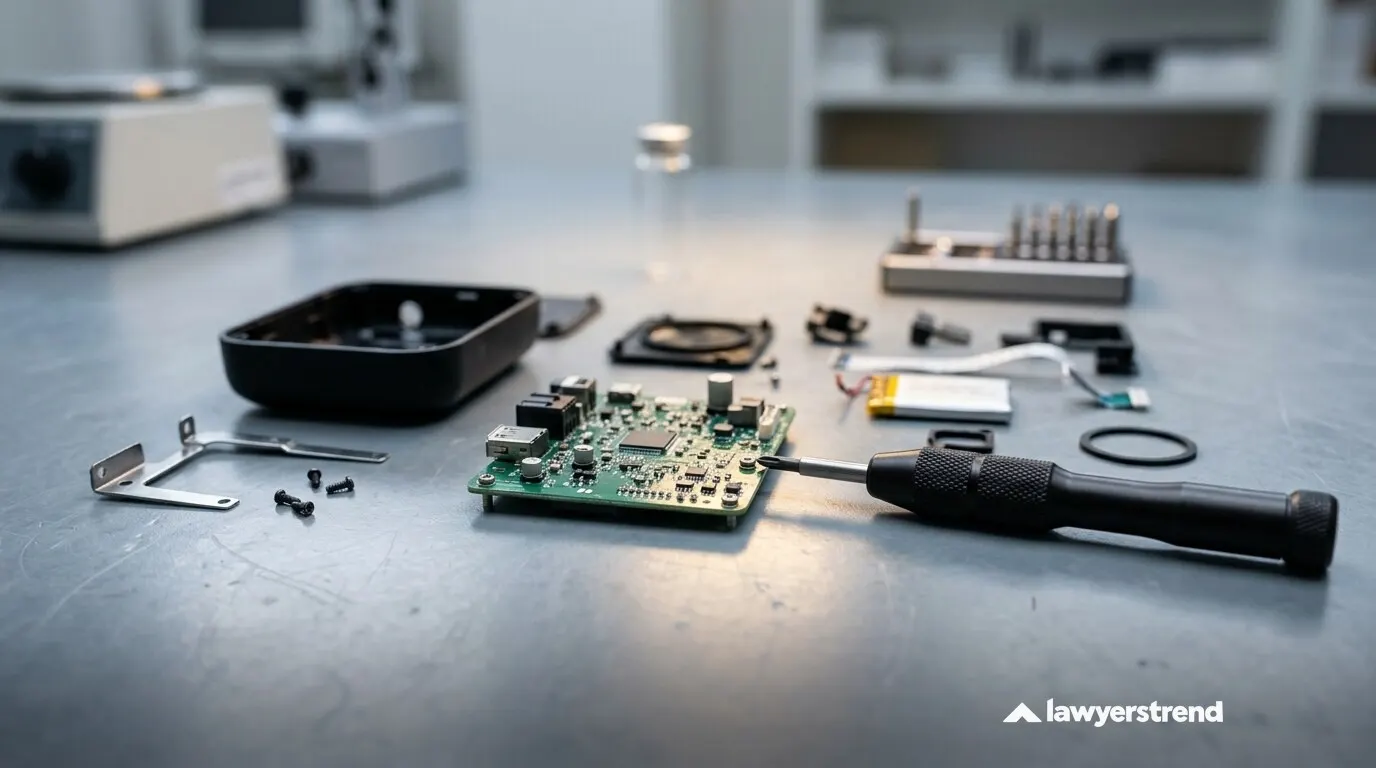
In most product liability cases, the single most important piece of evidence is the product itself: the exploded pressure vessel, the fractured ladder rail, the melted battery pack, the tire that delaminated at highway speed. Experts on both sides will build their opinions around its physical condition, and the most informative analysis often requires cutting, dissolving, or disassembling it in ways that cannot be undone. Handling that evidence correctly from the moment of the incident through destructive testing is one of the most consequential tasks in the file, and errors at this stage are often unrecoverable.
Securing the product
The product needs to come into controlled custody as soon as possible. In the hours and days after an incident, products are thrown away by family members, discarded by first responders, taken by insurers, or returned to retailers. Each transfer increases the risk of loss, alteration, and later challenges.
At intake, ask specifically where the product is and who has it. If it is still with the client, arrange for collection by the firm or a qualified evidence storage vendor. If it has been taken by an insurer, a fire investigator, or law enforcement, send a preservation letter immediately and request that it be held without testing or alteration. If the retailer or manufacturer has it, the preservation letter should be explicit that no testing, disassembly, or alteration may occur without notice and an opportunity to participate.
Collect related items as well: packaging, manuals, receipts, accessories, chargers, replacement parts, and any components that separated during the incident. A battery fire case without the charger is incomplete; a ladder case without the feet or locking mechanisms may be unprovable.
Documenting chain of custody
Chain of custody documentation answers a simple question: who had the product, when, and what did they do with it. A defensible chain includes:
- A record of each transfer with date, time, persons involved, and condition at transfer.
- Photographs at each transfer point.
- Sealed and labeled packaging, with seal integrity documented each time the package is opened.
- Storage in a facility with controlled access and environmental conditions appropriate to the material.
- A log of every person who examined the product and what they did.
Professional evidence storage vendors maintain these records as a matter of course and can testify to them. Storing the product in a firm's supply closet, even carefully, invites cross-examination.
Non-destructive examination first
Before anything is cut or disassembled, the product should be fully documented in its as-found condition. Standard non-destructive steps include:
- Comprehensive high-resolution photography from multiple angles and scales.
- Measurement and dimensional documentation.
- Radiography or computed tomography scanning, which can reveal internal structure, defects, and failure locations without disassembly. CT scanning has become standard in battery, electronic, and casting cases.
- Surface examination under magnification.
- Documentation of any markings, part numbers, lot codes, and date stamps.
Non-destructive examination should ordinarily be conducted under a joint protocol, with all parties invited. It establishes a shared baseline and often narrows the issues before destructive work begins.
The joint destructive testing protocol
Destructive testing alters or consumes the evidence. Doing it without notice to all interested parties, including potential defendants not yet named, risks spoliation sanctions, which can include adverse inference instructions, exclusion of expert testimony, or dismissal. The standard practice is a written joint protocol.
A sound protocol addresses:
- Parties and notice. Identify every party with a potential interest, including manufacturers, component suppliers, distributors, retailers, and insurers. Give written notice with enough lead time to allow participation.
- Location and laboratory. Agree on a neutral laboratory with appropriate capabilities.
- Sequence of steps. Describe each test or disassembly step in order, with clear decision points where the parties can confer before proceeding.
- Documentation. Require continuous video recording and photography of each step, with copies to all parties.
- Sample allocation. Where samples are taken, specify how they are divided and who retains them.
- Custody after testing. Address where the remaining product and samples will be stored and under what conditions.
- Costs. Allocate laboratory and storage costs, often shared equally among participating parties.
Disagreements over protocol steps are common. Defendants may push for steps that favor their theory, or resist steps that could reveal internal defects. When agreement fails, seek a court order establishing the protocol. Judges are generally receptive, since a court-ordered protocol reduces later spoliation disputes.
Notice to unnamed parties
One of the most frequent errors is failing to notify parties who are not yet defendants. A component supplier identified only after destructive testing can argue it was deprived of the opportunity to examine the evidence. Before testing, identify every manufacturer whose component might be implicated, and send notice even if the plaintiff does not intend to sue them. A party that received notice and declined to participate has little ground to complain later.
Exemplar products
Testing exemplar products, unused units of the same model and production period, can supplement and sometimes replace destructive testing of the incident product. Exemplars help establish whether a defect is inherent to the design or specific to the incident unit, and they allow experimentation without risking the primary evidence. Acquire exemplars early, before the product is redesigned or recalled and units become scarce.
When the product is gone
Sometimes the product is lost or destroyed before counsel is retained. That does not necessarily end the case. Circumstantial evidence, including photographs, witness accounts, exemplar testing, and evidence of similar failures, can support a defect inference in many jurisdictions. But the plaintiff's own responsibility for loss can trigger spoliation arguments against the plaintiff, so document how and when the product was lost. Related coverage appears in our product liability section and in our discussion of spoliation remedies under case law and settlements.
The bottom line
The failed product is evidence that both sides need and only one side usually controls. Secure it immediately, document every transfer, complete non-destructive examination first, and negotiate a written joint protocol with notice to every potentially interested party before anything is cut. Handled properly, the evidence becomes the foundation of the case. Handled carelessly, it becomes the defense's best argument.