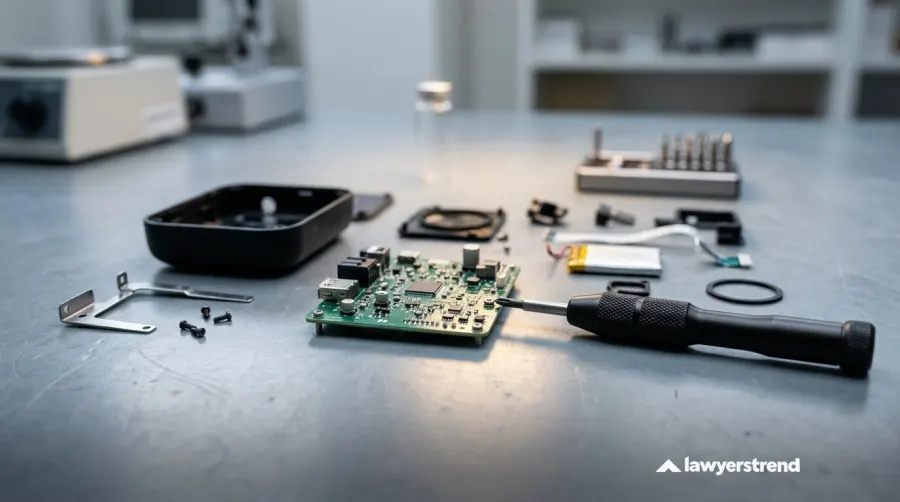
The textbook product case has the failed product on an evidence table, sectioned and photographed under magnification, with competing metallurgists arguing about the fracture surface. Many real cases look nothing like that. A space heater starts a house fire that leaves only a melted chassis. A vehicle component fails at highway speed and is lost in the wreck. A client throws out a broken appliance before ever calling a lawyer. In each situation, the plaintiff cannot identify the specific flaw. The malfunction doctrine, captured in Section 3 of the Restatement (Third) of Torts: Products Liability, is how those cases get to a jury.
The rule
Section 3 permits an inference that a product defect existing at the time of sale caused the plaintiff's harm, without proof of a specific defect, when the incident was of a kind that ordinarily occurs as a result of a product defect and was not, in the particular case, solely the result of causes other than a defect existing at the time of sale or distribution. The doctrine is close kin to res ipsa loquitur, and many jurisdictions recognized a version of it before the Restatement framed it. States vary in how they apply it, with some adopting Section 3 expressly and others reaching similar results through circumstantial evidence rules under their own strict liability law.
The doctrine does two things. It relieves the plaintiff of naming the precise manufacturing flaw, and it allows the jury to infer from the failure itself that something was wrong with the product. It does not relieve the plaintiff of proof. The burden shifts to the quality of the evidence ruling out other explanations.
Element one: the kind of incident that signals defect
The first question is whether the event is the type that ordinarily happens because of a defect. A new pressure regulator that ruptures during normal use, a nearly new tire that delaminates at moderate speed, or a sealed battery pack that ignites while idle on a counter fits that description. A product that fails after years of hard use, modifications, or obvious abuse does not, because many non-defect explanations are equally likely.
Expert testimony usually carries this element. An engineer familiar with the product category can testify that properly designed and manufactured units do not fail in the way this one did under the conditions described. Recall data, warranty claim histories, and similar incident reports support the testimony by showing that the failure mode is associated with defects in the field.
Element two: excluding other causes
The second element is where most malfunction cases are won or lost. The plaintiff must produce evidence sufficient to allow a jury to find that the failure was not solely caused by something other than a defect present at sale. The usual alternative causes are predictable.
- Age and wear. The older the product, the harder it is to attribute failure to a condition that existed at sale. Purchase records, warranty registration, and the client's testimony about use history are essential.
- Misuse and modification. Defense counsel will look for aftermarket parts, repairs by unqualified technicians, or use outside the product's intended purpose. Interview the client and household members early, and document the product's condition and history before the defense does.
- Maintenance. For vehicles and equipment, service records establish whether the product was maintained according to the manufacturer's schedule.
- External ignition or impact. In fire cases, the origin and cause investigation has to exclude other ignition sources in the area of origin. In crash cases, reconstruction has to show that the component failure preceded rather than resulted from the collision.
Courts do not require the plaintiff to eliminate every conceivable alternative. They require enough evidence that a reasonable jury could find the defect explanation more probable than not. But a gap in the history, such as an unexplained repair or a period when the product was in someone else's hands, can defeat the inference at summary judgment.
Fire cases as the paradigm
Residential and commercial fires produce many malfunction cases because the evidence is so often destroyed. A competent origin and cause investigation following NFPA 921 methodology is the foundation: it identifies the area of origin, inventories every potential ignition source in that area, and explains why each one other than the product can be excluded. Defense experts frequently attack the investigation for negative corpus reasoning, meaning a conclusion reached solely by eliminating other sources without positive evidence. The plaintiff's investigator should therefore document whatever physical evidence links the product to the fire, such as arc beads, internal damage patterns, or the product's position relative to burn patterns, rather than relying on elimination alone.
Preservation still matters
The malfunction doctrine is a fallback, not a substitute for preservation. Whatever remains of the product, including fragments, packaging, the manual, the receipt, and exemplar units from the same production lot, should be secured and documented. Notify the manufacturer and other potential defendants before any examination of the remains, and offer a joint inspection protocol. Spoliation by the plaintiff's side, even inadvertent, invites a sanction that can undo the circumstantial case entirely. When the product is truly gone, the client's own photographs and video, often on a phone, can be the most valuable evidence in the file.
Pleading and proof strategy
Plead manufacturing defect as the primary theory when the product is unavailable, because the malfunction inference fits best when a single unit departed from its intended design. Where the failure mode reflects a pattern across units, pair it with design defect and failure-to-warn theories supported by recall and incident evidence. Our product liability archive covers design defect tests and recall evidence, and our case law coverage tracks state decisions applying Section 3. A missing product makes the case harder, not impossible, if the record explains everything else.