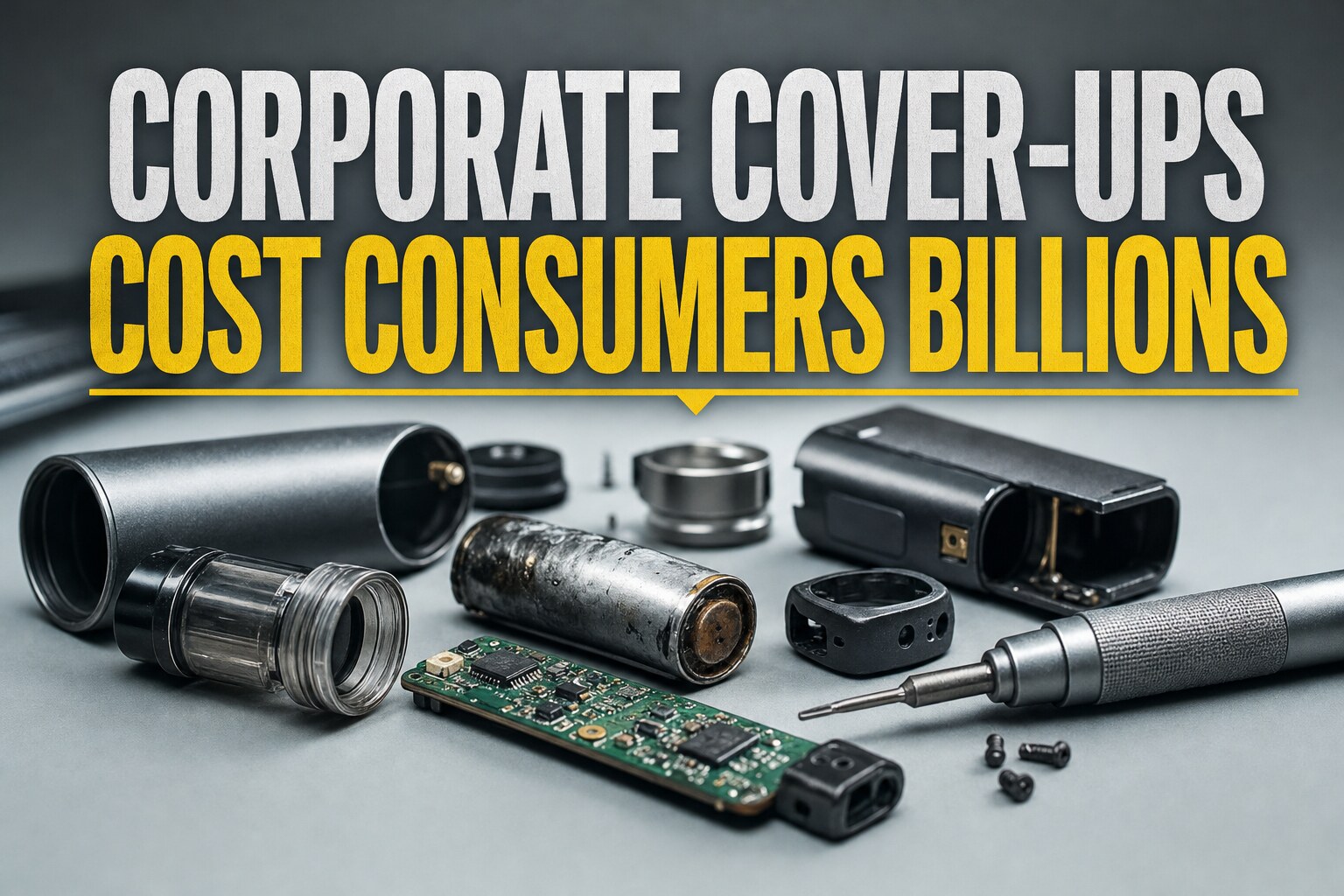
E-cigarette and vaping device battery explosions have generated a stream of product liability claims since vape devices went mainstream in the 2010s. The failure mode is consistent: the lithium-ion battery inside the device undergoes thermal runaway, a self-reinforcing exothermic reaction, and the battery vents or explodes while the device is in the user's pocket, in their hand during use, or charging on a surface nearby. The resulting injuries range from second-degree burns on the thigh or hand to partial-thickness facial burns when a device fails during use and eye injuries from ejected battery fragments. These cases present multiple product liability theories against a multi-party defendant chain that often includes a Chinese device manufacturer, a domestic distributor, and a retail vape shop or online marketplace.
The Two Dominant Failure Theories
Battery explosion claims in vaping device cases proceed on parallel tracks: manufacturing defect and design defect. Identifying which theory is stronger on the specific facts requires understanding the failure mode and the chain of custody of the specific device.
Manufacturing defect: A manufacturing defect claim alleges that the specific battery cell or device that failed deviated from the manufacturer's intended design due to a production flaw. In lithium-ion battery cases, common manufacturing defects include: contamination of the electrode material during production, internal short circuits caused by metal particle contamination or separator defects during cell assembly, and inadequate separator thickness that fails to prevent cathode-anode contact during normal thermal expansion. Manufacturing defect is the appropriate theory when the device failed in a way that a properly manufactured unit of the same design would not have, and when the failure mode is traceable to a specific production batch or supply chain anomaly.
Design defect: A design defect claim alleges that the entire product line is unsafe because the design itself creates an unreasonable risk of failure. In vaping device cases, design defect applies when: the device lacks a battery management system (BMS) chip that monitors cell voltage and temperature and disconnects the circuit before thermal runaway occurs; the device lacks a vent or pressure-relief mechanism that channels battery gases safely away from the user; the battery compartment uses a fixed-battery configuration that prevents replacement of a degraded cell; or the device's charging circuit does not incorporate overcharge protection. A risk-utility analysis comparing the device's design to available safer alternatives supports a design defect theory where cost-effective safety features were omitted from the design.
The Defendant Chain
Vaping device injury cases frequently involve a defendant chain with multiple responsible parties at different levels:
- The battery cell manufacturer: Most lithium-ion cells in vape devices are manufactured in China, Japan, or South Korea. When the failure is traceable to the cell's own defect rather than the device assembly, the cell manufacturer is a direct defendant. Obtaining the cell's manufacturer and production lot from the failed device requires early preservation of the physical evidence and expert analysis of the failed cell.
- The device assembler / brand: The entity that assembles the battery, circuitry, and housing into the finished device bears responsibility for the integrated product's safety, including the choice to omit a BMS, the adequacy of the housing's thermal management, and the warnings on the device and packaging about charging, storage, and replacement of batteries.
- The domestic distributor: A domestic distributor who imports and re-labels a foreign-manufactured device, or who sells the device under its own brand, is a seller in the stream of commerce and bears strict liability in most states under the bystander theory regardless of whether it had any role in the device's design or manufacture.
- The retail seller: The retail vape shop or online marketplace that sold the specific device to the plaintiff is a strict liability defendant in the distribution chain in states that impose liability on all commercial sellers. In states that limit retailer liability when the manufacturer is available for suit, the retailer may be released from the case at summary judgment, but keep the retailer in the case through discovery to obtain sales records identifying the manufacturer and distributor.