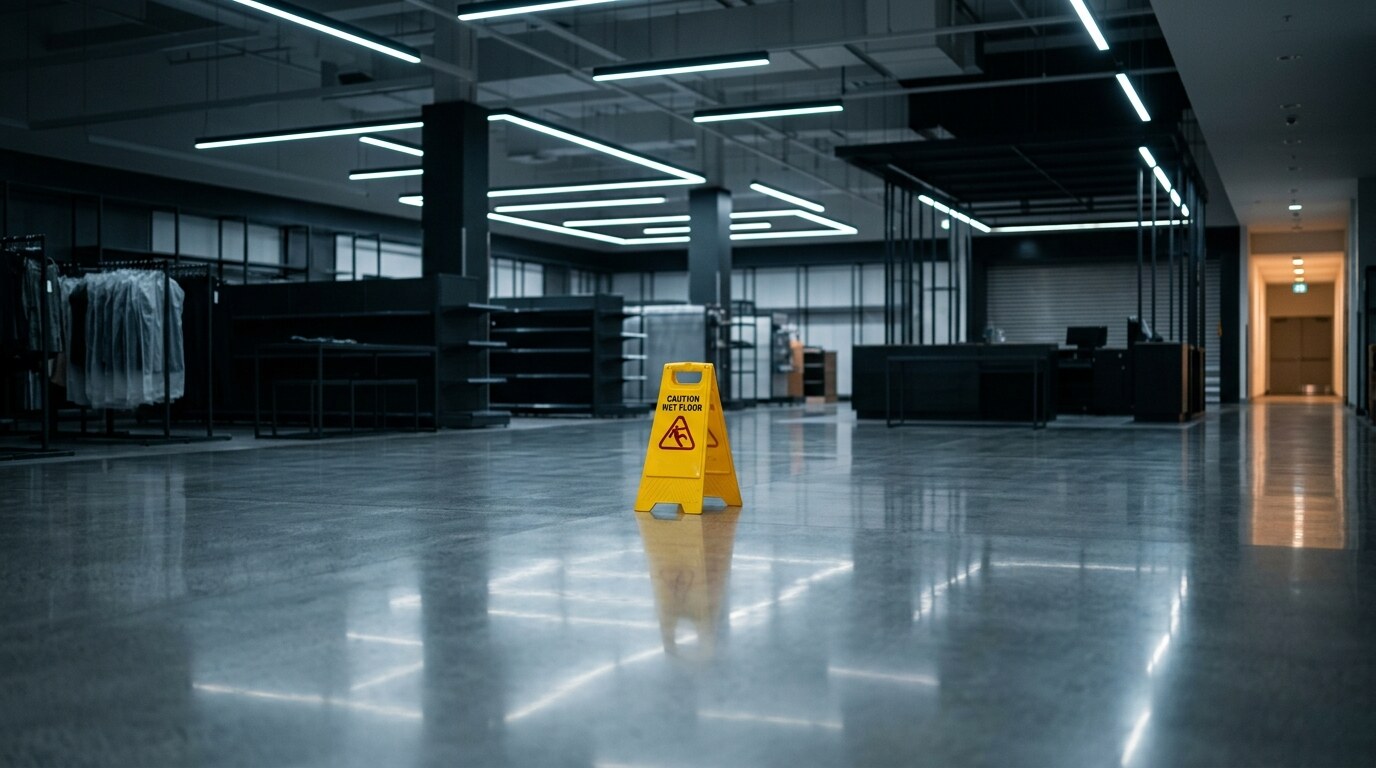
The notice fight dominates premises litigation: how long the spill sat, who should have seen it, when the last inspection ran. But a whole category of slip-and-fall cases does not turn on notice at all. They turn on whether the walking surface was unreasonably slippery in the first place, and that is not an argument, it is a measurement. A tribometer takes it.
When the floor itself is the hazard, the wrong tile for a wet entryway, a polished surface with no slip treatment, a coating worn smooth by traffic, the plaintiff may not need to prove the defendant knew about a transient spill. The dangerous condition is the surface the owner chose and maintained. Coefficient-of-friction evidence is how you prove it.
What the number actually measures
Coefficient of friction, COF, is the ratio of the force needed to slide a surface across the floor to the weight pressing them together. Higher means more grip. Investigators care about two versions: static COF, the resistance at the moment before movement, and dynamic COF, the resistance once a foot is already sliding. Both are captured with a tribometer, a calibrated instrument pressed or dragged against the floor under controlled conditions.
There is no single legal minimum written into most premises statutes, and any expert who claims a bright-line national threshold is overstating it. That said, a static COF around 0.5 has long served as a widely cited reference point for safe walking surfaces, and readings well below it on a surface people traverse in ordinary use are the readings that build cases. The value of the number is not that it declares a floor illegal. It is that it converts a slick floor from a subjective complaint into a quantified deviation from a recognized standard.
Standards give the number weight
Two ASTM standards do the heavy lifting. ASTM F2508 governs the validation of walkway tribometers, the protocol that establishes an instrument actually measures what it claims to measure. ASTM F1637 sets the standard practice for safe walking surfaces in buildings. An expert who tests with a validated instrument under a recognized method, and who ties the result to F1637, is offering the court a measurement grounded in consensus engineering practice rather than a personal opinion about slipperiness.
That grounding is what survives the admissibility challenge. Whether your jurisdiction applies Daubert or Frye, the recurring defense move is to attack the expert's method and instrument, not the qualifications. Use a tribometer validated under F2508, follow a published test procedure, and document every condition, and the objection tends to collapse into a weight-and-credibility argument for the jury rather than a bar to the testimony. Where an expert is minimally qualified, most courts treat the challenge as going to weight, not admissibility.
Test conditions decide the case
The single most important discipline is testing under conditions substantially similar to those at the time of the fall. A dry-floor reading is close to useless if the client slipped on a wet surface. If the floor was wet, test it wet, with the same contaminant where that can be replicated safely, because water, detergent, grease, and produce residue each change the reading. If the fall involved a particular contaminant, a defense expert who tests the floor bone dry and reports a compliant number is not measuring the case, and you should be prepared to say so.
Timing matters as much as condition. Surfaces change. Floors get refinished, mats get added, worn tile gets replaced, and a coefficient measured a year after the incident may describe a different floor than the one your client fell on. Get an inspection and testing on the surface early, before the defendant alters it, and photograph the surface at the same time. Where the floor has already changed, maintenance and floor-care records become the bridge back to its condition on the day in question.
Build the surface case, not just the reading
A COF number is strongest when it sits inside a larger record. Pull the floor-care contract and the product data sheets for whatever cleaner or coating the defendant used, because manufacturers often specify slip-resistance limits and application methods the defendant ignored. Request prior incident reports at the same location, which show the surface was a repeat offender. And check the original specification, an entryway designed for wet foot traffic that was tiled with a smooth interior product is a design choice, not an accident.
Assembled together, the tribometer reading, the standards, the maintenance failures, and the prior falls describe a hazard the owner created and kept, which is a cleaner theory than chasing constructive notice of a one-time spill. The expert cost is real, so reserve this workup for cases where the surface, not a transient substance, is the actual culprit.
We cover the constructive-notice and preservation battles in our slip and fall reporting, the admissibility fights over engineering experts in our product liability coverage, and the appellate treatment of premises theories in our case law and settlements desk.
The surface either met a recognized standard or it did not. When you can put that answer in front of a jury as a number rather than an adjective, the premises case stops being a debate about who noticed what and becomes a question of engineering the defendant cannot talk its way around.