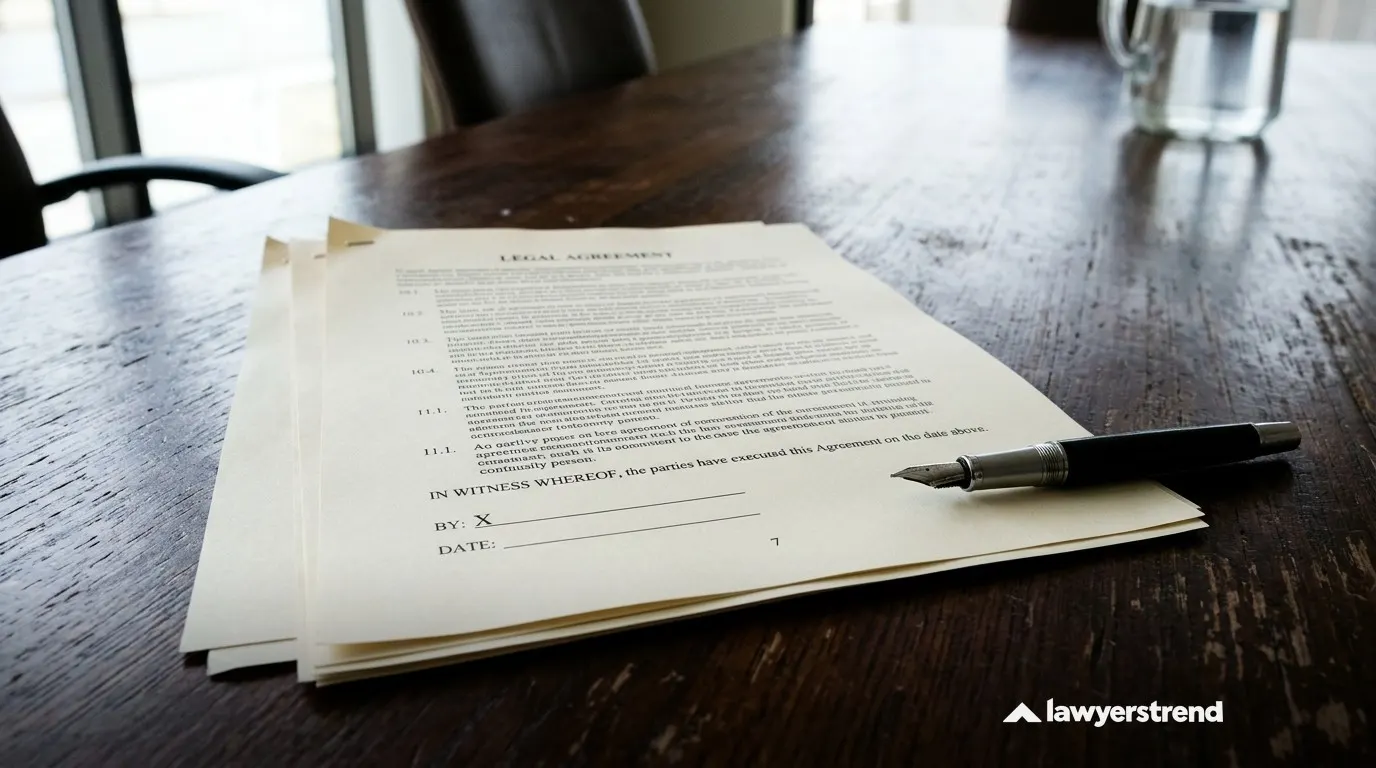
A client walks in with a separation agreement offering eight weeks of pay. It has a general release, a Civil Code section 1542 waiver, a mutual nondisparagement clause, a confidentiality clause covering "the facts and circumstances of Employee's employment and separation," and a no-rehire provision. HR has asked for a signature by Friday. Before you say anything about the dollar figure, you can probably show that two or three of those provisions violate California law as written.
Senate Bill 331, the Silenced No More Act, took effect January 1, 2022. It amended Government Code section 12964.5 and Code of Civil Procedure section 1001, extending California's limits on workplace secrecy from sex-based claims to every kind of harassment, discrimination, and retaliation. Nearly five years later, noncompliant templates still go out regularly. Plaintiff counsel can use that on two fronts: when reviewing a client's severance package before any claim is filed, and when drafting the settlement agreement that closes a filed case. The rules differ between those two situations, and confusing them is the most common mistake.
The Statutory Architecture
Code of Civil Procedure section 1001 was first enacted in 2018 by SB 820, the STAND Act. It voids any provision in a settlement agreement that prevents disclosure of factual information about claims filed in a civil action or a complaint filed in an administrative action concerning sexual assault, sexual harassment, or sex-based workplace harassment and discrimination. SB 331 extended it to workplace harassment or discrimination on any basis protected by FEHA, failure to prevent harassment or discrimination, and retaliation for reporting either. Offending provisions are void as a matter of law and against public policy.
Government Code section 12964.5 covers agreements that are not settlements of filed claims. Subdivision (a) addresses agreements signed as a condition of employment or in exchange for a raise or bonus. Subdivision (b) addresses agreements related to an employee's separation from employment. Under subdivision (b), an employer may not include a provision in a separation agreement that prohibits disclosure of information about unlawful acts in the workplace. Any nondisparagement or confidentiality clause must also carry specific carve-out language.
Government Code section 12953 makes a violation of section 12964.5 an unlawful employment practice under FEHA. The practical effect is that a noncompliant severance agreement can support its own FEHA claim, with FEHA's administrative exhaustion requirements and its fee-shifting.
Severance Agreements: The Section 12964.5(b) Checklist
If the client has not filed anything (no lawsuit, no CRD complaint, no internal complaint), the agreement in front of you is a separation agreement governed by section 12964.5(b). Check it against four requirements.
The mandatory carve-out language
Any nondisparagement or confidentiality provision must include language substantially similar to: "Nothing in this agreement prevents you from discussing or disclosing information about unlawful acts in the workplace, such as harassment or discrimination or any other conduct that you have reason to believe is unlawful." Variants that limit the carve-out to "communications with government agencies" or "as required by law" do not meet the standard. The statute protects disclosure to anyone, including coworkers, family, the press, and social media.
The attorney-consultation notice
The employer must notify the employee of the right to consult an attorney about the agreement and must give the employee a reasonable period of at least five business days to do so. The employee can sign sooner by choice, but the employer cannot require it. A Friday deadline on an agreement handed over on Wednesday is a violation on its face.
If the client is 40 or older, the federal Older Workers Benefit Protection Act sets a longer timeline for any release of age claims under the ADEA: 21 days to consider (45 days in a group termination program), a seven-day revocation period, and specific disclosure requirements under 29 U.S.C. section 626(f). Check both regimes.
The prohibited-disclosure scope
Look past the carve-out paragraph to the operative confidentiality language. A clause that bars disclosure of "any information concerning Employee's employment" or "the circumstances of Employee's separation" has the purpose or effect of preventing disclosure of unlawful acts unless the carve-out clearly overrides it. If the drafting leaves the employee guessing about whether describing a supervisor's conduct breaches the agreement, the statutory purpose is defeated.
What remains permissible
Section 12964.5 does not prevent employers from protecting trade secrets, proprietary information, or confidential business information that does not involve unlawful acts in the workplace. The employer may also keep the severance amount confidential. Spend negotiating capital on the provisions that are actually void.
Settlement Agreements: The Section 1001 and Negotiated-Settlement Rules
When the client has filed a claim in court, with an administrative agency, in an alternative dispute resolution forum, or through the employer's internal complaint process, the analysis changes. Section 12964.5 exempts a "negotiated settlement agreement" resolving such a claim from its separation-agreement rules. The statute defines a negotiated settlement as voluntary, deliberate, and informed, providing consideration of value to the employee, where the employee was represented by counsel or given notice and an opportunity to retain counsel.
That exemption does not remove the section 1001 restriction. In a settlement of a filed harassment, discrimination, or retaliation claim, you still cannot agree to a provision that prevents your client from disclosing factual information about the claim. What section 1001 does allow is a provision, at the claimant's request, shielding the claimant's identity and all facts that could lead to discovery of that identity, including pleadings filed in court. That option belongs to the client, not the defendant. The settlement amount may also be kept confidential.
The drafting consequence is clear. A defense draft that says "the parties agree to keep the terms of this Agreement and the facts underlying the Action confidential" combines a lawful term (amount) with a void one (underlying facts). Rewrite it to cover only the settlement amount and, if your client wants it, a claimant-identity shield. If the client prefers anonymity, record that the request came from the client. That one sentence prevents a later dispute over whether the shield was imposed.
No-Rehire, Noncompete, and Testimony Clauses
No-rehire provisions
Code of Civil Procedure section 1002.5 prohibits settlement agreements from barring an aggrieved person who filed a claim against the employer from working for the employer, its parent, subsidiaries, divisions, affiliates, or contractors. AB 2143 (effective 2023) narrowed the exception. An employer may include a no-rehire term only if it made and documented a good-faith determination, before the aggrieved person filed the claim, that the person engaged in sexual harassment, sexual assault, or criminal conduct. Ask defense counsel to produce the pre-filing documentation, or remove the clause.
Noncompete and no-employment clauses
Business and Professions Code section 16600, as strengthened by SB 699 and AB 1076 effective 2024, voids contracts that restrain anyone from engaging in a lawful profession, trade, or business, and section 16600.5 makes it unlawful to enter into or try to enforce such a contract. The California Supreme Court rejected a "narrow restraint" exception in Edwards v. Arthur Andersen LLP (2008) 44 Cal.4th 937. The Ninth Circuit applied section 16600 to a no-employment provision in a settlement agreement in Golden v. California Emergency Physicians Medical Group (9th Cir. 2018) 896 F.3d 1018, holding that a provision restraining a substantial share of the plaintiff's practice falls within the statute.
Testimony waivers
Civil Code section 1670.11 voids waivers of the right to testify about criminal conduct or sexual harassment when testimony is compelled or requested by a court, agency, or legislature. Broad "will not voluntarily assist any party adverse to the Company" language is common. Where the clause would reach compelled testimony on those subjects, it is unenforceable to that extent.
The Federal Overlay
Two federal developments sit on top of the California scheme. The Speak Out Act of 2022 (42 U.S.C. sections 19401 to 19404) makes pre-dispute nondisclosure and nondisparagement clauses unenforceable in sexual assault and sexual harassment disputes. It reaches clauses signed before a dispute arose, such as an onboarding confidentiality agreement the employer later invokes.
The NLRB's 2023 decision in McLaren Macomb held that offering non-supervisory employees severance agreements with broad confidentiality and nondisparagement terms can violate Section 8(a)(1) of the NLRA. The current Board's approach to that decision is uncertain, and the General Counsel's guidance memo applying it has been rescinded. Treat it as a supplementary argument, not the main one. California's statutes do not depend on how federal labor law develops.
Using Defects at the Negotiating Table
A noncompliant severance agreement gives you three practical openings.
First, it gives you a reason to slow things down. An agreement without the five-business-day notice, or with a signature deadline inside that window, lets you reset the timeline without seeming obstructive.
Second, it can support an independent claim. Because section 12953 makes a section 12964.5 violation an unlawful employment practice, a client who was offered unlawful terms has a FEHA claim that does not depend on the merits of the underlying termination, subject to the usual CRD exhaustion requirements.
Third, it affects severability later. If the client already signed a defective agreement before coming to you, the void provisions do not necessarily undo the release, since courts generally sever unlawful terms under Civil Code section 1599 when the central purpose of the contract is lawful. But an employer that tries to enforce a void confidentiality or no-rehire clause has given you a counterclaim and a story. Document every enforcement threat.
Firms that handle employment matters alongside PI work, or refer them out, should keep a one-page checklist covering these statutes. The Los Angeles employment-law practitioner guide lists local counsel who handle these reviews as a regular part of their practice.
The Bottom Line
The Silenced No More framework comes down to one question: is the agreement resolving a claim the client has already made, or is it a separation package offered before any claim? Section 12964.5(b) controls the second category, with mandatory carve-outs and a five-business-day consultation window. Section 1001 controls the first, with a factual-disclosure rule that gives the client, not the employer, control over anonymity. Get the category right before you read the confidentiality clause, and you will usually find the defect in the first pass.