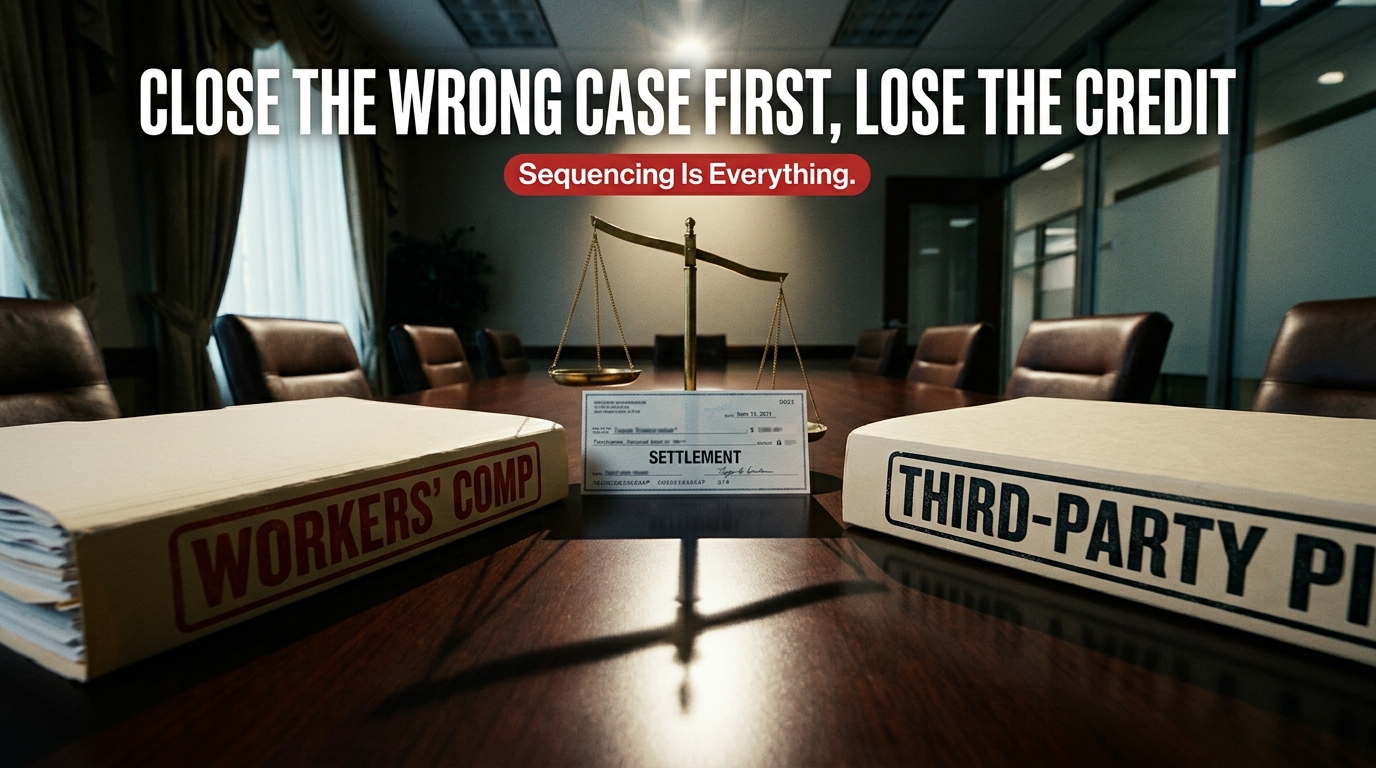
You take the case as a workplace injury with an obvious third-party defendant — a scaffold that collapsed, a delivery truck that ran the light, a defective press that took two fingers. Now you are running two files at once: a workers' compensation claim in front of the Board and a third-party civil action in Superior Court. They resolve on different calendars, in front of different judges, under different rules. And the order in which you close them can swing your client's net recovery by six figures.
Most plaintiff attorneys treat the comp case and the PI case as parallel tracks that happen to share a plaintiff. They are not parallel. They are wired together by Labor Code sections 3850 through 3862, and the wiring runs in one direction: the comp carrier's right to reimbursement and its right to a credit against future benefits both attach to whatever you recover from the third party. Sequencing is the plaintiff-side move that decides how much of that money the carrier gets to touch.
The Two Rights the Carrier Holds
Understand the carrier's position before you decide anything. Under Labor Code section 3852, an employer that has paid compensation may recover what it paid from the third party who caused the injury, either by its own action or by lien against the employee's recovery under section 3856. That is the lien — backward-looking, tied to benefits already paid.
The second right is the one that ruins otherwise good settlements. Under Labor Code section 3861, the Appeals Board is enable to allow the employer a credit against future compensation liability up to the amount of the employee's net third-party recovery. So after your client cashes the PI settlement, the comp carrier can stop paying — no more indemnity, no more medical — until the credit is exhausted. If the third-party money is large and the future comp exposure is larger, the credit can wipe out years of benefits your client was counting on.
The lien is a number you negotiate down. The credit is a structural claim on the future. They behave differently depending on which case you close first, which is exactly why the order matters.
Closing the Comp Case First
If you resolve the workers' compensation claim before the third-party case, you are usually choosing between a Compromise and Release and Stipulations with Request for Award. The distinction controls your credit exposure downstream.
A Compromise and Release closes the comp file. Future medical and indemnity are bought out for a lump sum, subject to Board approval. Once that happens, there is far less "future compensation" left for the carrier to assert a credit against — you have converted the open-ended future into a fixed past payment, and the credit under section 3861 has little to bite. The carrier's remaining interest collapses into a lien number on money already paid, which you then reduce in the PI settlement.
Stipulations with an open future-medical award are the opposite. If you take stips and leave future medical open, then settle the PI case for a substantial sum, the carrier can march into the Board and ask for a credit against every future treatment your client needs. You will have closed the comp case in name while leaving the most valuable part of it — lifetime medical — exposed to being swallowed by the third-party proceeds. Where future medical is real and expensive, a Compromise and Release before the PI resolution is frequently the plaintiff-protective play.
Closing the PI Case First
Settle the third-party case first and you hand the carrier its section 3861 credit on a platter. The recovery is now a known, liquidated number; the comp case is still open; and the carrier will assert a credit against future benefits equal to the client's net after attorney fees and costs. Your client keeps the PI money but may receive nothing further from comp for a long time.
That is not automatically the wrong choice. If the third-party settlement dwarfs the remaining comp exposure — a policy-limits payout on a case where future medical is modest — the credit is cheap and closing PI first lets you distribute money now. The danger is the mismatched case: a large open future-medical need and a third-party recovery big enough to trigger a credit but not big enough to actually fund that future care out of pocket. In that scenario, closing PI first can leave the client with a check today and no benefits tomorrow.
There is a defensive maneuver here that too few practitioners use: build the future-medical need into the PI damages and the comp resolution in tandem, so the client is not paying twice for the same care once the credit attaches. The collateral source rule after Howell shapes how those medical damages get proven in the civil case, and comp payments do not reduce the tort recovery even as they generate the lien and credit that follow it.
Witt v. Jackson and Shrinking the Lien
Whichever case closes first, the size of the carrier's lien is negotiable, and employer fault is your strongest tool. Under Witt v. Jackson (1961) 57 Cal.2d 57, when the employer's own negligence contributed to the injury, that comparative fault reduces — and can eliminate — the employer's reimbursement and credit. If the scaffold failed because the general contractor ignored a known hazard, the carrier's lien shrinks by the employer's percentage of fault, and its future credit shrinks with it.
Develop employer fault in discovery even when you have no intention of suing the employer — you cannot, given the exclusive-remedy bar, but you can raise it as a defense to the lien. A credible Witt v. Jackson showing routinely turns a full-dollar lien into a fraction of that, and it does so before you ever argue the credit at the Board.
The common-fund doctrine is the second discount. Under Quinn v. State of California (1975) 15 Cal.3d 162 and Labor Code section 3856, the carrier that benefits from your work on the third-party recovery must bear a proportional share of your attorney fees and litigation costs. The lien comes off the top only after the carrier pays its fair share of producing the fund. Make the carrier account for that share in writing before you agree to any lien number.
The Board Has the Last Word on Credit
Do not assume the Superior Court can bless your allocation of the settlement and bind the comp carrier. The Appeals Board holds jurisdiction over the credit question, and it decides how much future comp the third-party recovery offsets. A civil-side stipulation that characterizes proceeds as pain-and-suffering rather than lost earnings does not automatically control what the Board treats as the "net" for credit purposes. If you want an allocation to hold, you generally need it addressed where the credit lives — at the Board, ideally in the same resolution that closes the comp file.
This is also where coordination with the underlying liability posture pays off. When the third-party carrier is exposed to a verdict beyond limits, the settlement dynamics change, and the reasoning in our piece on bad-faith failure to settle can reframe what the third-party recovery looks like — which in turn changes the credit math on the comp side. And where a federal benefit plan sits alongside the comp lien, the recovery rules stack differently; our coverage of the FEHB plan lien most attorneys overlook is a reminder that the comp carrier is rarely the only hand reaching for the same dollars.
A Practical Sequencing Checklist
Before you close either case, price the future comp exposure. If future medical is large and open, favor a Compromise and Release on the comp side first, so there is little future benefit left for a credit to attack. If the third-party recovery clearly exceeds all remaining comp exposure, closing PI first and accepting the credit may be fine — and faster for the client. Develop employer fault early to shrink the lien and the credit under Witt v. Jackson. Insist on the carrier's common-fund contribution to fees before agreeing to any lien figure. And resolve the allocation and credit at the Board, not just in the civil file, if you want it to stick.
The order you close these cases is not a scheduling accident — it is a substantive decision that decides who keeps the third-party money. Price the future first, then choose the sequence that protects it.