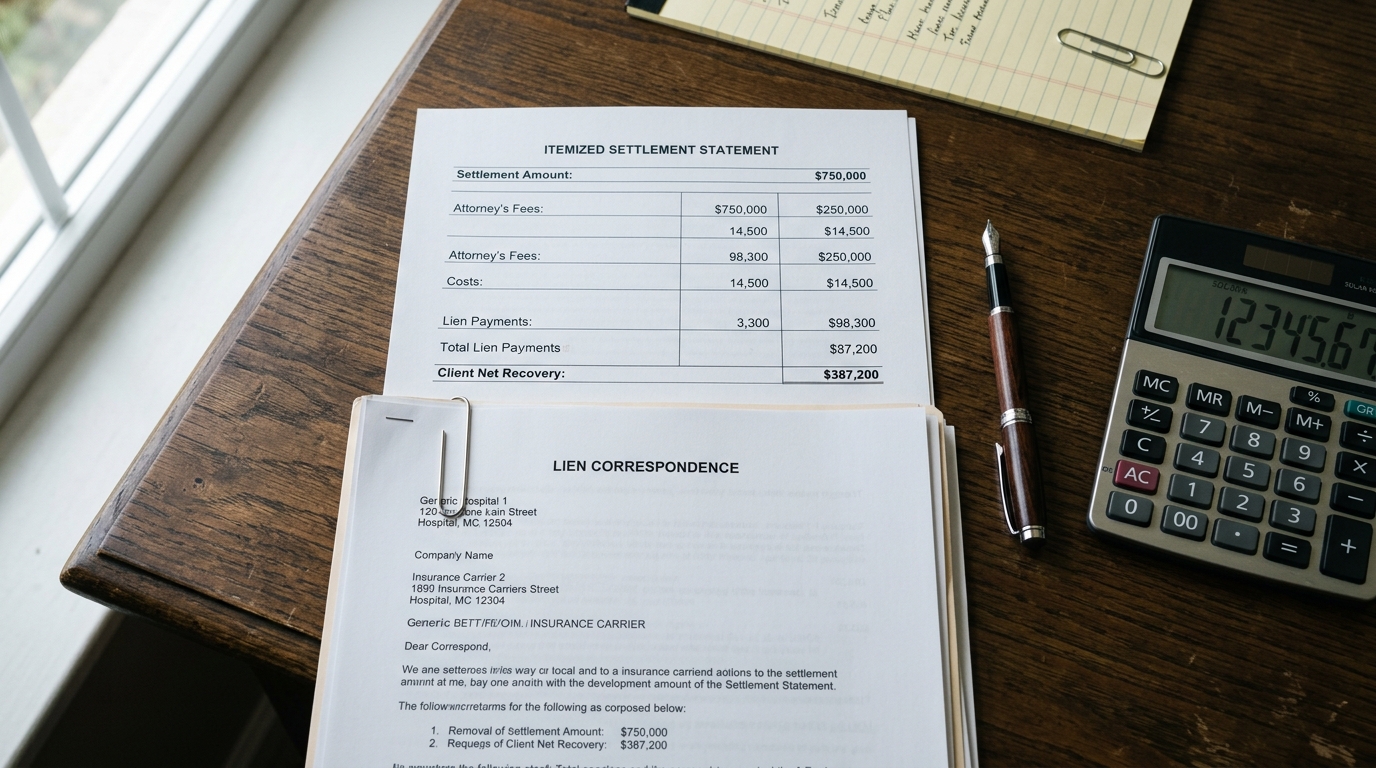
The defense check clears trust on a Tuesday. By Friday, the client has texted twice asking when the wire lands. Between those two events sits the highest-risk window in plaintiff practice — the stretch where a single math error, a missed Medi-Cal notice, or a too-fast disbursement turns a clean recovery into a State Bar referral.
Disbursement is the phase the client remembers, and the phase the bar will read line-by-line if anything goes wrong. What follows is a working sequence for California PI firms running settlements from twenty-five thousand to seven figures. The steps barely move with case size; the documentation burden does. Treat the sequence as a hard checklist, because the order in which money leaves trust is what separates a clean file from a Business & Professions Code § 6068(m) problem.
Deposit Posture and the Hold Period
When the defense draft hits the office, the first decision is which trust account receives it. Funds that will earn meaningful interest for the client — generally anything above a few hundred thousand expected to sit for more than a few weeks — belong in a separate interest-bearing trust account titled to the client. Everything else goes to IOLTA. California Rule of Professional Conduct 1.15 was rewritten in 2023, and the notice-to-financial-institution obligations were sharpened again this year. Firms that have not refreshed their IOLTA paperwork in the last twelve months should read our coverage of the July 1 RPC 1.15 deadline before the next reconciliation cycle.
Hold the funds until the check has actually cleared. Bank availability schedules are not clearance. For paper drafts on carrier checking accounts, seven to ten business days is the working norm; structured settlement company drafts and large MGA paper sometimes take longer. Disbursing on a Reg CC provisional credit and then having the draft come back unpaid is a fact pattern the Office of Chief Trial Counsel sees repeatedly, and the lawyer is on the hook for the negative balance regardless of intent.
Building the Lien Picture Before You Touch the Money
The moment the funds clear, the lien file should already be substantially built. Statutory liens get priority and the longest lead time. Medi-Cal demands come through the DHCS portal under Welfare & Institutions Code § 14124.70 et seq., and final demands are quoted as of a specific date — let them go stale and you re-paper the request. Medicare conditional payment work runs through the BCRC up to settlement, then transfers to the CRC; ignoring the reporting windows under the MSP regulations exposes the firm to double-damages liability. ERISA self-funded plans require a written demand and a copy of plan language; the plan can rebut common-fund doctrine in writing, and many do.
Hospital liens under Civil Code §§ 3045.1–3045.6 attach to emergency and ongoing care from the facility but are capped at reasonable charges. Letter-of-protection providers and lien-basis treaters have no statutory priority but do hold a contract signed by the client. Subrogation from private health insurance is governed by the plan document and California's anti-subrogation rules for fully-insured plans — most cannot reach the recovery, but assuming so without reading the plan is malpractice.
Verbal payoff numbers are worth nothing. Every reduction has to be in writing, on letterhead, with a through-date. Our staffing piece on the lien resolution workflow covers how mid-size firms run this work without bottlenecking disbursement.
The Order of Operations
The arithmetic has to run in a fixed order, and the retainer agreement controls any ambiguity. The standard California PI sequence:
1. Gross settlement received. 2. Attorney fee deducted per the contingency contract. Most California PI retainers compute on gross before costs and liens; some compute on net of costs. The retainer governs, and the State Bar will read it before they read your math. 3. Case costs reimbursed. Advanced costs under CRPC 1.8.5 — filing fees, experts, depositions, records, service of process — return to the firm operating account, not the lawyer's pocket directly. 4. Lien pool calculated from what remains. 5. Lien payoffs disbursed per negotiated demands. 6. Net to client.
The fee-on-gross convention exists because the fee is earned on the recovery, not on what the client takes home after a hospital lien. On cases where the lien pool will swallow the client's share, many practitioners voluntarily haircut the fee under common-fund principles — both to keep the client whole and to give the lienholders moral pressure to reduce. Document any voluntary reduction in the disbursement memo so the file shows it was a discretionary act, not a fee-shifting concession.
Cutting Medical Down
Civil Code § 3040 is the workhorse statute on the medical share. It caps reimbursement from a settlement to a healthcare service plan, hospital, or licensed provider at the lesser of the contracted amount or one-half of the plaintiff's net recovery after attorney fees and costs. Many lienholders quote full billed charges and wait to see whether counsel knows the statute. They do not always know it themselves.
Howell v. Hamilton Meats limits recoverable medical damages at trial to amounts actually paid, but Howell does not by itself reduce a lien — the lien math runs on its own statutory and contractual track. The doctrinal point worth holding firmly: billed charges that no one ever paid do not become a lien just because the provider sends a demand letter. Reasonableness of the underlying charges is reviewable, a point covered in our recent piece on lien billing reasonableness and PE consolidation that has changed how some carriers price their demands.
Common-fund and equitable subrogation principles let counsel push pro-rata fee and cost reductions onto most lienholders. Medi-Cal applies a 25% statutory reduction off the top under § 14124.72(d) when an attorney is involved, plus pro-rata costs. Medicare's procurement-cost calculation reduces the conditional payment lien by the same ratio that fees and costs bear to the gross. ERISA plans with strong no-common-fund plan language can block the reduction, but only with the plan document in hand — demand it, in writing, and assume the language is favorable to you until proven otherwise.
The Disbursement Memo and Client Sign-Off
Nothing leaves trust without a signed disbursement statement. The memo itemizes every line — gross, fee, each cost category, each lien payee with a dollar figure, net to client — and the client signs it before any wire goes out. Some firms have the client initial each line. The memo is the document the bar will subpoena first if a fee dispute or grievance arrives, and it is the document a fee arbitrator will read before anything else.
Hold back a reserve for late-arriving Medicare conditional payment letters and for any lien you have not received a final closure on. A common error is disbursing one hundred percent on a soft-close Medicare number and then receiving a revised demand two months later. The reserve sits in trust, fully ledgered, and gets released to the client once the lien finally closes. Build the hold-back number into the signed memo so it is not a surprise.
Issue 1099s where the IRS rules require — generally to lien-basis treating providers paid through the trust account — and document the analysis for those you do not. The reporting question is fact-specific and case-specific, and getting it wrong creates a tax problem for the firm, not just for the client.
Where Firms Get Disciplined
The pattern of trust-account discipline cases is monotonous. Disbursement before liens close. Commingling — the firm's earned fee left sitting in trust to smooth payroll. Borrowing against the client share to advance another case's costs. Reconciliations that do not reconcile. Failure to keep individual client ledgers showing every deposit, every withdrawal, and a running balance.
The new CRPC 1.15 framework, with its sharper notice and self-reporting requirements, has made these problems easier for the bar to find. Banks now flag overdrafts directly to the State Bar. A single bounced check off the client trust account triggers an audit posture that most solo and small firms are not ready to receive. The cure is not heroic — three-way reconciliations every month, two-signature workflows above a threshold, and a refusal to ever cut a disbursement check on a draft that has not posted as collected funds.
The discipline cases almost never start with theft. They start with a lawyer who let a deposit sit, a lien drift, or a reconciliation slide for a quarter, then tried to catch up under deadline pressure. Disbursement is the part of plaintiff practice where speed and accuracy actively trade against each other, and the wrong answer is always to move faster.
This article is for general information for California plaintiff personal-injury practitioners and is not legal advice. Verify all statutory cites and current State Bar guidance before applying to a specific matter.