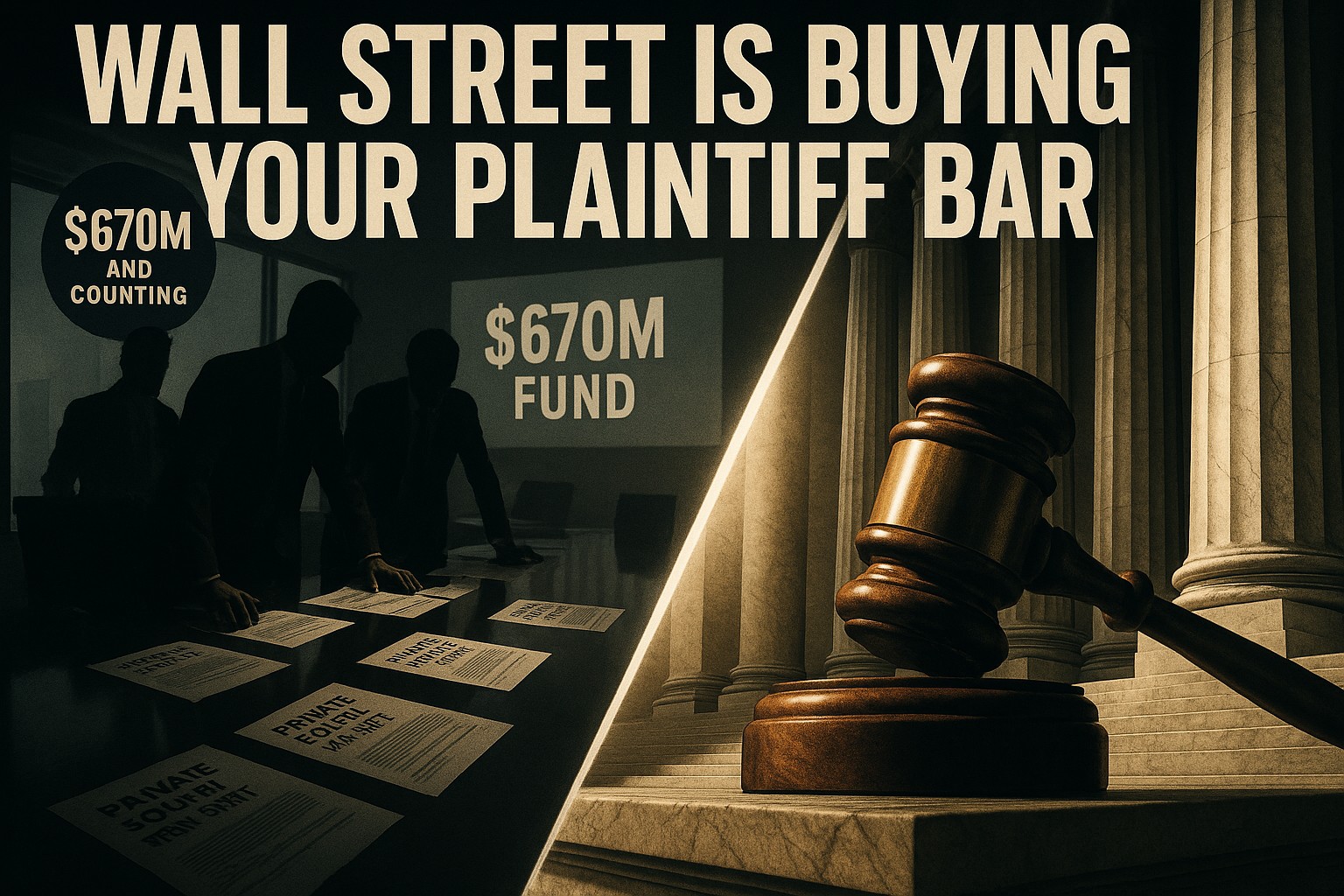
Private Equity's MSO Blitz Accelerates Across the Plaintiff Bar
The capitalization of plaintiff personal injury firms crossed a structural threshold this week. Rafi Law Group, the Houston-and-Atlanta plaintiffs shop, closed a $125 million PE investment in April 2026, structured through a management services organization, using the template that Apollo Global Management and Fortress Investment Group have been deploying across the sector, per Bloomberg Law. Uplift Investors went further, launching a $670 million dedicated PI-firm fund and bundling four announced MSO co-investment deals into its Orion Legal platform to centralize back-office, marketing, and technology functions across partner firms.
The biggest signal came from Morgan & Morgan, the largest U.S. plaintiff PI firm by headcount, which engaged JPMorgan in 2026 to structure a capital raise reported at more than $1 billion, with an eventual IPO pathway under discussion. That figure, if finalized, would dwarf every prior PE transaction in the plaintiff bar and mark the segment's formal entry into institutional asset allocation.
The counter-pressure is organized. Illinois, California, and Colorado advanced legislation in 2026 to restrict PE fee-sharing arrangements. California's pending AB provision would require bar approval for any MSO arrangement giving non-attorneys more than a de minimis economic interest in law firm revenue. The January 8, 2026 ruling in Chong v. Mardirossian Akaragian LLP (CA Court of Appeal, 2nd Dist., B341157) illustrates what is at stake: client Christopher Chong terminated his firm before settlement finalized, and the court held his later ratification of the $6,015,000 settlement related back to the authorization date, entitling the firm to its full $2,706,750 contingency fee plus prejudgment interest. Chong netted approximately $2,149,000. For every PI firm, PE-backed or not, the ruling is a directive to document client authorization at each settlement stage rather than rely on post-hoc ratification.
For medical providers entering lien or letter-of-protection arrangements with PE-backed PI firms, the MSO layer adds a contractual counterparty that may differ from the named law firm on intake paperwork. Providers should request ownership structure documentation before extending credit and build account-receivable terms that account for the additional billing intermediary.
The MSO model is now the dominant capitalization and succession vehicle in plaintiff PI, and firms that have not audited their fee documentation practices against the Chong standard are carrying unnecessary exposure.
Geller v. Uber Closes the Rideshare Arbitration Exit in Wrongful-Death Cases
On September 24, 2026, the Illinois Supreme Court decided Geller v. Uber Technologies, et al. (No. 132066), holding that a wrongful-death survivor cannot be compelled to arbitrate under a rideshare agreement signed exclusively by the deceased rider. Gloria Sheridan Geller's claim arising from the April 2022 fatal crash at Chicago Midway Airport, in which her husband Mark Geller died during an Uber trip, survived the company's motion to compel arbitration. Clifford Law Offices, with partner Charles R. Haskins as lead argument counsel, litigated for the Geller estate.
The practical reach extends beyond Illinois. Uber's Terms of Service contain materially similar arbitration provisions across every state, and the court's reasoning tracks U.S. Supreme Court arbitration doctrine in ways that carry persuasive weight in the Seventh Circuit and parallel federal litigation. Any plaintiff firm currently holding a TNC fatality file with a pending motion to compel arbitration should treat September 24 as the date that argument's shelf life shortened considerably.
Intake economics also shifted. The threat of mandatory arbitration was among the primary friction points that made rideshare wrongful-death cases expensive to develop on contingency. With that shield cracked in the most commercially active midwestern jurisdiction, the risk-reward ratio for accepting those files improved materially.
Geller v. Uber (No. 132066) is binding in Illinois and persuasive nationally; counsel with active TNC wrongful-death files should re-evaluate any pending arbitration motion before responding to the next scheduling order.
Jackson v. Corizon: $307.6M Federal Verdict Benchmarks Institutional Healthcare Liability
An Eastern District of Michigan federal jury on April 2, 2026 returned a $307.6 million verdict in Jackson v. CHS TX Inc. (Case No. 2:19-cv-13382): $300 million in punitive damages against CHS TX Inc., the Corizon Health successor, $7.5 million compensatory to plaintiff Kohchise Jackson, and $100,000 in punitives against Dr. Keith Papendick for deliberate indifference. The underlying conduct: Jackson was denied a colostomy-reversal surgery for two years while incarcerated, with the delay documented internally as a cost-cutting measure. Jonathan F. Marko and Marko Law PLLC in Detroit served as lead trial counsel.
The punitive ratio, roughly 40-to-1 over compensatory, will be tested on post-trial motions under the BMW v. Gore and State Farm v. Campbell line of cases. The jury's willingness to reach that figure signals institutional-accountability claims are not getting discounted in the Eastern District of Michigan. Private prison healthcare contractors manage medical services in dozens of state correctional systems nationwide; the verdict establishes a direct liability benchmark for firms building those dockets.
For medical providers, this verdict signals where new plaintiff-side demand is developing. Prison healthcare litigation is generating large verdicts and attracting well-capitalized counsel into a space with historically sparse plaintiff-side infrastructure. Providers experienced in treating patients transitioning out of incarceration, or with records tied to correctional-system treatment decisions, should expect increased demand for expert review and records analysis through at least mid-2027.
The $307.6 million Jackson verdict against CHS TX Inc. is one of the largest healthcare-negligence awards in U.S. history and is likely to expand the correctional-healthcare-liability docket heading into 2027.
Boston Scientific Infinion CX Recall Opens Q4 Device-Liability Docket
The FDA's September 2026 Class I recall of the Boston Scientific Infinion CX spinal cord stimulator lead system is tied to 1,081 reported serious injuries attributed to lead fractures. Class I is the FDA's most severe recall classification, reserved for devices where use may cause serious adverse health consequences. The Infinion CX system is implanted in patients with chronic refractory pain, a population disproportionately represented in PI plaintiff files given the overlap with traumatic injury sequelae.
For plaintiff counsel, the recall seeds a products-liability docket with several structurally favorable features: a defined product class, a federal regulatory finding of unreasonable risk, and a reported-injury count large enough to generate MDL pressure once individual case filings reach consolidation thresholds. Some Infinion CX fracture claims will nest inside existing personal injury files as additional counts, because chronic-pain patients with implanted SCS systems frequently have underlying traumatic injury claims already in litigation.
Medical providers are the identification front line. Physicians, pain management practices, and surgical centers that have implanted Infinion CX leads should audit patient panels now. Providers who document device removal or replacement contemporaneously and facilitate timely referrals will be positioned as cooperative fact witnesses rather than secondary defendants. The recall record, including FDA adverse-event submissions, is accessible through the MAUDE database and already discoverable in related litigation.
The Infinion CX recall's 1,081 serious-injury count and Class I designation make it one of the more significant device-liability seedings of Q4 2026; medical providers with implant registries should initiate patient outreach before MDL consolidation compresses the referral window.
New York's 50% Fault Bar Reshapes the Nation's Largest Auto-PI Market
Effective May 26, 2026, New York CPLR § 1411(b) imposed a 50% modified comparative fault bar applicable exclusively to motor vehicle cases: any plaintiff found more than 50% at fault recovers nothing for pain and suffering. The statute simultaneously eliminated the 90/180-day serious-injury category from Insurance Law § 5102(d). The plaintiff bar's consensus assessment is that the reform will concentrate trial resources on clear-liability cases, an intake discipline already encoded into screening protocols at major NY plaintiff PI firms.
The NHTSA final EDR rule, effective June 17, 2026, adds an evidentiary dimension that interacts directly with the new fault bar. Pre-crash data capture expanded from 5 seconds at 2 Hz to 20 seconds at 10 Hz. That 20-second window can expose sustained speeding, delayed braking, or erratic steering pre-impact. In New York, this data is now discoverable through CPLR Article 31 demands or subpoenas to telematics providers. Plaintiffs with clean pre-crash EDR records carry stronger evidence of defendant fault; plaintiffs with adverse pre-crash records face a threat that, combined with the 50% bar, can defeat a claim before it reaches a jury.
The open question for the NY plaintiff bar heading into Q4 2026 is whether telematics subpoenas will be routinely contested on proportionality grounds or become standard discovery in every contested auto file by Q1 2027.