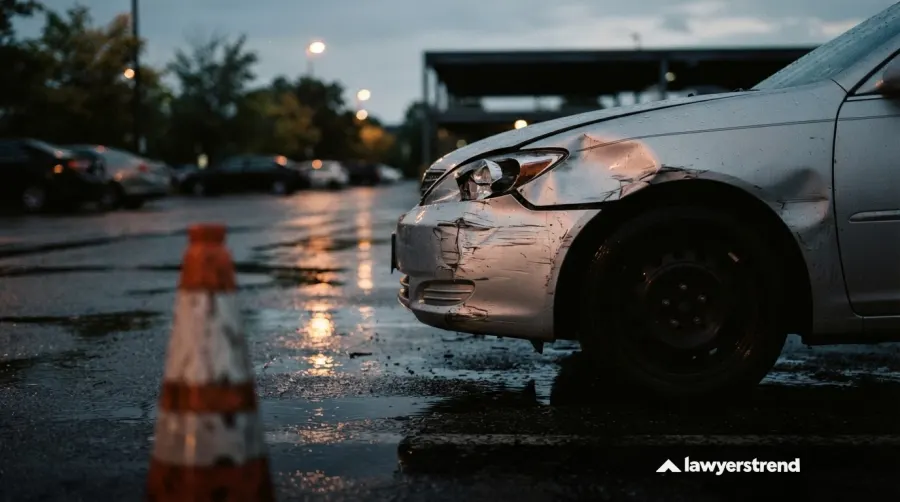
Parking lot collisions are high-frequency, modest-value claims that many firms treat as low priority. That is understandable but expensive. These crashes regularly produce real injuries, particularly to pedestrians and to occupants struck broadside at low speed in a vulnerable position. And because carriers default to a 50/50 liability split on most two-car lot collisions, the firm that can prove fault clearly is often the only one that gets full value.
Why carriers default to a split
The split-liability offer reflects real uncertainty. Lots have fewer marked lanes, fewer signs, and no traffic signals. Both drivers are often moving slowly and claim the other came out of nowhere. Police frequently do not respond to private-property crashes without injury, and when they do, they may decline to issue a citation. Without an independent account, adjusters treat the case as a credibility contest and split it.
Breaking the split requires evidence that answers the question the adjuster cannot: who had the right of way, and who failed to yield.
Do the traffic statutes apply?
In many states, a large portion of the vehicle code applies only on public highways, defined to exclude private property. Some provisions, such as those prohibiting reckless or impaired driving, typically apply everywhere. States and localities also have mechanisms to extend certain rules to privately owned roads open to the public. The applicable rules vary by state and sometimes by property.
The practical point is that negligence still applies even where a specific traffic statute does not. Courts and juries look to the general standard of reasonable care, and the rules of the road remain persuasive evidence of what reasonable drivers do. Expert and lay testimony can establish common parking-lot conventions, and posted signage, painted arrows, and stop bars on the property inform what a reasonable driver should have done.
Through lanes and feeder lanes
The most useful framework for lot collisions distinguishes through lanes, the main travel lanes that run along the perimeter or connect entrances and exits, from feeder lanes, the rows that run between parked cars. As a general convention, traffic in through lanes has priority over vehicles entering from feeder lanes, much as traffic on a through street has priority over a side street. Drivers leaving a parking space must yield to traffic already in the lane.
Common collision patterns and their usual fault analysis:
- Backing out of a space. The backing driver typically bears primary fault, because backing requires yielding to traffic in the lane. The defense will argue the other driver was speeding or distracted.
- Two vehicles backing simultaneously. These are the hardest cases and the most likely to produce a genuine split.
- Feeder lane entering a through lane. The vehicle in the feeder lane generally must yield.
- Competing for the same space. Fault turns on who was in position first and whether the other driver cut across.
- Cutting diagonally across empty spaces. A driver ignoring lane markings by cutting across rows is a strong comparative-fault target.
Evidence that ends the debate
Lot collisions happen in some of the most heavily surveilled spaces in the country. Retailers, banks, fuel stations, and shopping centers typically have exterior cameras covering lots and entrances. The challenge is retention: many systems overwrite in days or weeks. A preservation request to the property manager, the anchor tenant, and any adjacent business should go out within days of intake. Ask for footage from before the crash, which shows each vehicle's path and speed.
Other evidence sources include:
- Dashcam footage from either vehicle or from parked vehicles nearby.
- Event data recorders, which can capture speed, braking, and gear position, including whether a vehicle was in reverse.
- Damage patterns. A rear bumper corner impact on one car and a side impact on the other is consistent with backing into crossing traffic.
- Photos of the lot's lane markings, arrows, and signage, taken promptly in case the lot is restriped.
- Witness information from store employees and cart attendants.
For more on vehicle data in low-speed cases, see our auto accidents coverage.
The property owner as a defendant
Most lot collisions are driver-versus-driver cases. Some are not. A property owner or manager can share liability when the lot's design or maintenance contributed to the crash:
- Missing or faded stop bars and directional arrows at known conflict points.
- Inadequate lighting that prevented a driver from seeing a pedestrian.
- Obstructed sight lines from landscaping, signage, or seasonal displays.
- Pedestrian crossings without markings from the parking field to store entrances.
- Speed bumps or traffic calming that were removed or never installed despite prior incidents.
Prior incident history is the key discovery target. Lot owners and retail tenants often keep incident logs that show repeated collisions or near-misses at the same location. That history establishes notice, and a premises theory adds an additional policy, often a commercial general liability policy with substantial limits, to a case that might otherwise be limited to a minimum auto policy. For the premises side of this analysis, our premises liability coverage discusses notice and prior-incident discovery.
Pedestrian strikes
Pedestrian injuries in parking lots are often more serious than vehicle-to-vehicle collisions, particularly backover incidents involving older adults and children. Rear cameras and parking sensors are now standard on new vehicles, and the defense may argue the pedestrian walked into the path of a vehicle whose driver had no realistic chance to see them. Vehicle data and camera footage can show whether the driver checked the camera or responded to sensor alerts.
Valuing the case
Low speed does not mean low injury, but the defense will run a minimal-impact argument in almost every lot collision. Document the vehicle damage thoroughly, including hidden structural damage revealed in repair estimates, and connect the client's injuries to the mechanism with treating physician testimony. Broadside impacts at low speed can still produce significant lateral loading on the occupant nearest the impact.
Bottom line
The 50/50 offer is the carrier's opening position, not a finding. Lot collisions are winnable when counsel moves quickly on video, builds the right-of-way analysis around through and feeder lanes, and evaluates the property owner as a potential defendant from the start.