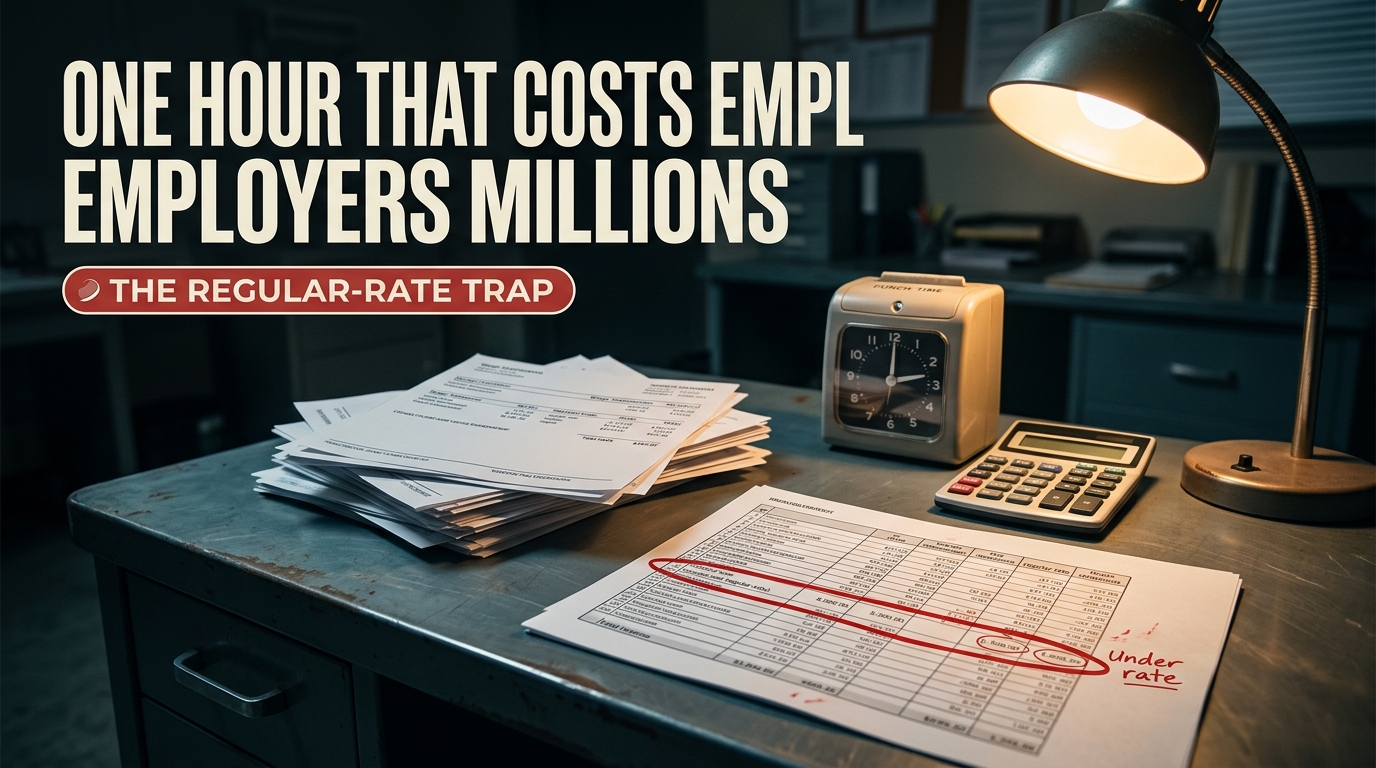
The premium under Labor Code section 226.7 is one of the shortest remedies in the wage-and-hour code: "one additional hour of pay at the employee's regular rate of compensation" for each workday a compliant meal or rest period was not provided. Attorneys read that sentence, assume it means one hour at the base hourly rate, and undervalue the claim before they have run a single number. The two words that decide the case are "regular rate," and the California Supreme Court spent a decade telling us they do not mean what most timekeeping systems assume.
Getting the premium right is a three-part exercise: identify the workdays that trigger it, price each hour correctly, and then trace the downstream penalties that attach because the premium is a wage. Miss any one of those and you have either left money on the table or over-pleaded a claim that will not survive a demurrer. What follows is the working math, not the doctrine as an abstraction.
The premium is a wage, not a penalty
Start here because it controls everything downstream. In Murphy v. Kenneth Cole Productions, Inc. (2007) 40 Cal.4th 1094, the court held that the section 226.7 payment is a wage, not a penalty. That single characterization sets a three-year statute of limitations under Code of Civil Procedure section 338, extendable to four years when you plead the derivative unfair-competition claim under Business and Professions Code section 17200. It also means the premium accrues, can be recovered as unpaid wages, and — as later cases confirmed — carries the same enforcement consequences as any other unpaid wage.
Treating the premium as a wage rather than a fine is not a rhetorical preference. It is the reason a modest per-day figure compounds into a claim worth pursuing, and it is the doctrinal hinge for the penalties discussed below.
What triggers the premium
Liability comes from Brinker Restaurant Corp. v. Superior Court (2012) 53 Cal.4th 1004. On meal periods, the employer's duty is to provide the period — relieve the employee of all duty, relinquish control, and permit a reasonable opportunity to take an uninterrupted 30 minutes — not to see that no work is performed. The timing rule is concrete: the first meal period must start before the end of the fifth hour of work, and a second before the end of the tenth hour. A late meal period is a violation, not just a missed one.
Rest breaks run on a separate clock. Brinker confirmed the "four hours or major fraction thereof" standard: 10 net minutes of paid rest per four hours worked, with "major fraction" meaning more than two hours. So a shift over six hours earns two rest breaks, over ten earns three. Because meal and rest obligations are distinct, they generate distinct premiums, which matters when you reach the daily cap.
Each triggering workday produces one premium hour in that category. The unit of recovery is the day, not the shift or the pay period, so your damages model has to be built at the day level from the time records.
The regular rate of compensation
This is where most calculations go wrong. In Ferra v. Loews Hollywood Hotel, LLC (2021) 11 Cal.5th 858, the court held that "regular rate of compensation" in section 226.7 is synonymous with the "regular rate of pay" used to compute overtime under Labor Code section 510(a). The premium is therefore not the base hourly wage. It is the base wage plus nondiscretionary bonuses, shift differentials, commissions, piece-rate earnings, and other non-excludable compensation, blended into an hourly figure. Ferra applies retroactively, so periods before the 2021 decision are in play within the limitations window.
Work an example. An employee earns $20 per hour, works 45 hours in a week, and receives a $150 nondiscretionary weekly production bonus. The regular rate is not $20. It is total straight-time compensation divided by hours worked: (($20 × 45) + $150) ÷ 45 = $1,050 ÷ 45 = $23.33 per hour. Every meal and rest premium that week is paid at $23.33, not $20. If the employer's payroll system booked the premium at base rate — as most do by default — the underpayment is roughly $3.33 per premium hour, per employee, per triggering day, across the class. That is the arithmetic that turns a single provision into a certifiable case.
Working the flat-sum bonus math
The regular-rate divisor is its own fight when a bonus is a flat sum rather than production- or output-based. In Alvarado v. Dart Container Corp. of California (2018) 4 Cal.5th 542, the court held that a flat-sum bonus is allocated only to the non-overtime hours the employee worked, which raises the per-hour value of the bonus and, in turn, the regular rate. A percentage-of-total-earnings bonus and a per-piece bonus follow different allocation rules, so you cannot apply one divisor across every incentive plan.
Practical consequence: before you can price a single premium hour, you have to classify each pay component in the defendant's compensation plan and confirm whether it is discretionary (excludable) or nondiscretionary (included). Discovery on bonus-plan documents and payroll formulas is not a side issue; it sets the multiplier on the entire damages model. Two identical hourly rates with different bonus structures yield different premium values.
The daily cap and the derivative penalties
Section 226.7(c) caps recovery at one additional hour per workday for meal-period violations and one additional hour per workday for rest-period violations. Those are two separate caps, not one — an employee who missed both a compliant meal period and a compliant rest break on the same day recovers two premium hours that day. What you cannot do is stack multiple meal premiums or multiple rest premiums within a single workday.
The larger money is often derivative. In Naranjo v. Spectrum Security Services, Inc. (2022) 13 Cal.5th 93, the court held that because premiums are wages, unpaid premiums can support waiting-time penalties under Labor Code section 203 for former employees and wage-statement penalties under section 226 when the statements omit them. A subsequent round of the same litigation addressed the good-faith defense to those penalties, so the section 203 and 226 exposure is not automatic — the employer's state of mind is litigable, and you should plead and prove around it rather than assume the penalties follow. Still, the derivative layer frequently exceeds the premium itself, which is why defendants fight liability on the underlying break so hard. The same wage-versus-penalty framing that drives premium recovery echoes the damages-characterization fights we track in collateral source disputes after Howell: how a payment is labeled controls what it is worth.
Records, presumptions, and where the case is won
Proof turns on the time records. In Donohue v. AMN Services, LLC (2021) 11 Cal.5th 58, the court held that employers may not round meal-period punches, and that time records showing short, late, or missed meal periods raise a rebuttable presumption of a violation. That presumption shifts the practical burden: once your records show the pattern, the employer must come forward with evidence that a compliant period was provided and the employee chose to work or shorten it. Build the case from the punch data, run the day-level premium model at the correct regular rate, and let the presumption carry the liability question.
One structural warning before you file. Wage claims are the natural habitat of arbitration and class-waiver clauses, and the enforceability of those clauses moves quickly — the reasoning in decisions like Geller v. Uber on severing an arbitration clause is the kind of analysis that decides whether your premium class ever reaches a classwide number. Check the agreement before you scope the case, not after.
The provision is one sentence. The value is in the divisor. An employer that pays every premium at base rate while the workforce earns bonuses, differentials, or commissions is underpaying a wage on every triggering day, and each underpayment can pull section 203 and 226 exposure behind it. Price the regular rate correctly first; the rest of the case is built on that number.