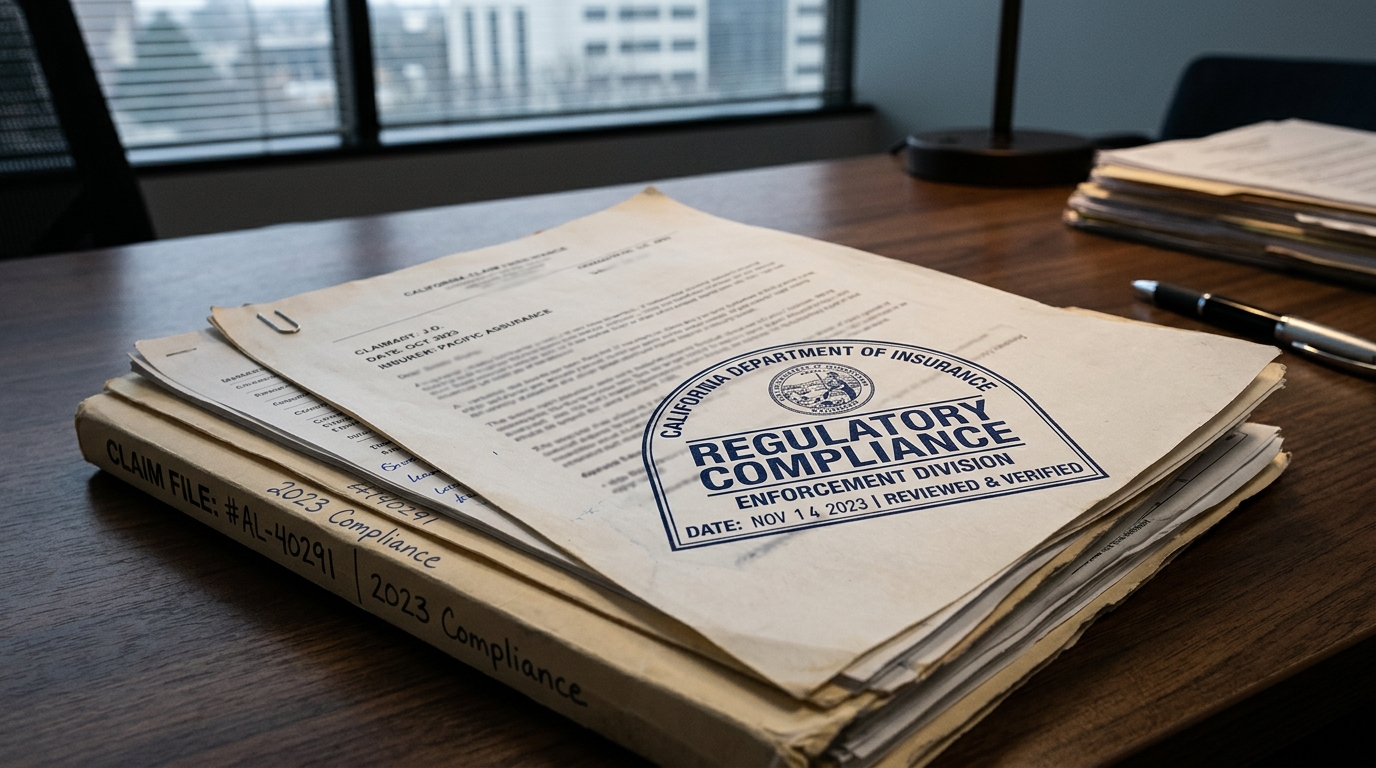
California's Insurance Commissioner has spent the last eighteen months pushing on auto carriers and their third-party administrators in ways that matter for plaintiff PI work. Market conduct examinations, consent orders, and contested rate filings under Proposition 103 are generating a public record of how carriers handle bodily injury claims, total losses, and medical payments coverage. The administrative track rarely produces a private right of action, but the documents it generates land squarely in bad-faith discovery and policy-limits negotiations.
For working plaintiffs' counsel, the question is operational. How do you fold a Department of Insurance market conduct report into a §998 strategy? When does a consent order shift the calculus on a policy-limits demand letter under the Comunale-Crisci-Johansen line? The answer starts with knowing what the Commissioner has actually done — and what doctrinal hooks let you use it.
The Statutory Framework Still Runs Through §790.03(h)
The Unfair Insurance Practices Act, codified at Insurance Code §790.03(h), lists the practices the Commissioner may sanction. Misrepresenting policy provisions, failing to acknowledge claims promptly, failing to adopt reasonable standards for prompt investigation, and compelling insureds to litigate by offering substantially less than the amounts ultimately recovered all sit on that list. The Fair Claims Settlement Practices Regulations in title 10 of the Code of Regulations, sections 2695.1 through 2695.17, put time limits and documentation requirements on each step.
Moradi-Shalal v. Fireman's Fund Ins. Co. (1988) 46 Cal.3d 287 closed the door on private actions under §790.03(h) itself. What survives is the use of these standards as evidence of the duty of good faith and fair dealing in a first-party bad-faith case, and as the substantive content of negligence per se theories in some third-party contexts. The Commissioner's findings under §790.03(h) supply admissions about what reasonable claims handling looks like. Carriers that have entered consent orders have effectively conceded the standard.
Prop 103 Rate Filings Are Not Just Premium Theater
The backlog of Proposition 103 rate filings that built up between 2020 and 2024 is finally clearing, and the prior-approval decisions coming out of the Commissioner's office contain detailed actuarial findings on loss costs, defense and cost containment expense, and loss adjustment expense. Those numbers matter to PI lawyers because they reveal what carriers project for bodily injury severity in California.
Read a recent personal auto rate order and you will find specific projections for BI severity trend, frequency trend, and the percentage of claims expected to involve attorney representation. Carriers that file for double-digit increases are admitting their reserves anticipate larger BI payouts. That admission travels. It belongs in the file when you are arguing that a $25,000/$50,000 limits demand is reasonable on a soft-tissue case with a credible workup, because the carrier's own actuarial position concedes that the universe of California BI claims is paying more, not less.
Consumer Watchdog and other intervenors under Insurance Code §1861.10 file detailed objections in these proceedings. The intervenor record — depositions of carrier actuaries, internal expense studies, and reinsurance treaties — becomes public through the rate case. For practitioners working repeat-player carrier files, those exhibits are a primary source on how the carrier internally values claims like yours.
Recent Market Conduct Examinations Show Pattern Failures
Market conduct examinations conducted under Insurance Code §730 et seq. follow a structured sample of claim files. The examiner pulls files, scores each against the §2695 regulations, and produces a report identifying violations. Recent reports affecting auto and umbrella carriers have flagged three recurring problems that show up in plaintiff PI files.
First, delayed acknowledgments. Regulation 2695.5(b) requires acknowledgment within fifteen calendar days. Carriers using offshore call centers or fragmented claim assignments routinely miss this. The report numbers — sometimes thirty to forty percent of sampled files non-compliant on this single line item — make a useful exhibit in a bad-faith deposition.
Second, failure to conduct a reasonable investigation under §2695.7(d). Examiners have cited carriers for closing files without obtaining police reports, ignoring medical records the claimant submitted, and refusing to interview disclosed witnesses. Each closed file with that pattern is a §790.03(h)(3) violation in the administrative record.
Third, lowball offers without explanation. Section 2695.7(b)(3) requires a carrier denying or compromising a claim to provide the basis in writing with reference to the applicable policy provisions or factual basis. Reports have cited carriers for using software-generated demands that strip context and produce explanations that do not match the file. This finding pairs directly with the legal standard set in Wilson v. 21st Century Ins. Co. (2007) 42 Cal.4th 713, which holds that the genuine dispute defense requires more than a thin paper record.
Translating Regulatory Findings Into Litigation Posture
The administrative track and the civil track interlock in three places. The first is the policy-limits demand. When a carrier sits on a clear liability claim with damages obviously exceeding limits, the Comunale-Crisci-Johansen doctrine puts the carrier on the hook for an excess judgment if its refusal to settle within limits is unreasonable. A pattern of §2695 violations in the carrier's market conduct record makes that refusal harder to defend at trial. The carrier's expert will testify that the file was handled within industry standards; the Commissioner's recent findings against the same carrier are public evidence to the contrary.
The second is the §998 offer. A statutory offer to compromise served early, with a damages package matching the actuarial assumptions the carrier filed with the Commissioner, narrows the carrier's room to claim reasonableness. If the carrier rejects and the verdict comes in above the offer, the post-judgment fight over expert fees and prejudgment interest is helped by every prior admission about claim severity.
The third is bad-faith discovery proper. Once a first-party case is in suit, the carrier's internal claim guidelines, training materials, and adjuster performance metrics become discoverable. Market conduct findings give you the road map. Request the files the examiner sampled, request the carrier's response to the report, request the remediation plan filed with the Department. These are non-privileged business records, not work product, and a motion to compel cites the regulatory record as proof of relevance.
Counsel working on the third-party side of the same fact pattern should pay attention to the same documents. Coordination with first-party bad-faith counsel — common in catastrophic injury cases where UM/UIM coverage under §11580.2 is in play alongside a third-party tender — produces a unified file that uses the administrative record on both fronts. The California trend toward larger BI verdicts, the same pattern that surfaced in our weekly recap covering recent rulings and SB 371 fallout, is feeding the rate filings and creating the actuarial paper trail.
Practitioner Workflow for Tracking the Administrative Record
The Department of Insurance publishes consent orders, stipulated judgments, and final examination reports on its public site. The PDF library is not indexed in a way that makes case research easy, but the documents are searchable by carrier name and by date. For each carrier that appears repeatedly in your case inventory, build a folder of every public action over the last five years. Update quarterly.
Calendar the comment periods on rate filings for carriers you face. The intervenor record in those proceedings is the cheapest source of admissions you will find — paid for through the §1861.10 intervenor fee award, not by you. Cite the resulting rate order in pre-litigation demand letters; carriers often do not know their own actuarial filings are being thrown back at them.
Public records requests under the California Public Records Act, Government Code §7920.000 et seq., reach Department correspondence that is not yet posted. The Department's response time is slow but the records exist. Frame requests narrowly — examination workpapers for a named carrier within a date range — and prepare for the exemptions to be claimed. The negotiation that follows usually produces something useful.
The same instinct that drives the discovery push in cases like Sargenti v. City of Long Beach, where constructive notice rests on a paper trail the public entity created, applies here. Carriers create paper trails for the Commissioner that they do not create voluntarily for plaintiffs. Use the regulatory record to do work your own discovery cannot.
What to Watch Through the Rest of 2026
Three lines of administrative activity will shape PI practice through the back half of this year. The first is the Commissioner's continued attention to claim handling at the largest personal auto writers, where rate increases approved in 2024 and 2025 came with consent-order conditions about claim service standards. Those conditions have reporting requirements. The first reports are coming due.
The second is the regulatory response to AI-driven claim valuation tools. The Department has signaled that algorithmic claims platforms must meet the §2695 standards regardless of the technology underneath, which sets up a fight over whether software-generated explanations satisfy the duty to explain. The doctrinal trajectory mirrors the one being argued in the EvenUp PLAAS dispute and the broader California fee fight, just inverted — carriers are getting the same scrutiny on their inputs that plaintiffs' firms now face on theirs.
The third is umbrella and excess. Rate filings on personal umbrella policies in California are running hot because the limits matter most in the cases with the largest verdicts. Carriers seeking double-digit increases on umbrella premiums are putting their severity assumptions on the record. Plaintiff lawyers handling cases where umbrella coverage is in play should be reading those filings line by line.
The administrative record is not a substitute for the work of building a case file. It is the most underused source of carrier admissions California plaintiff PI practice has. The lawyers who track it get a structural edge in the cases where the carrier's claim handling is the real story.