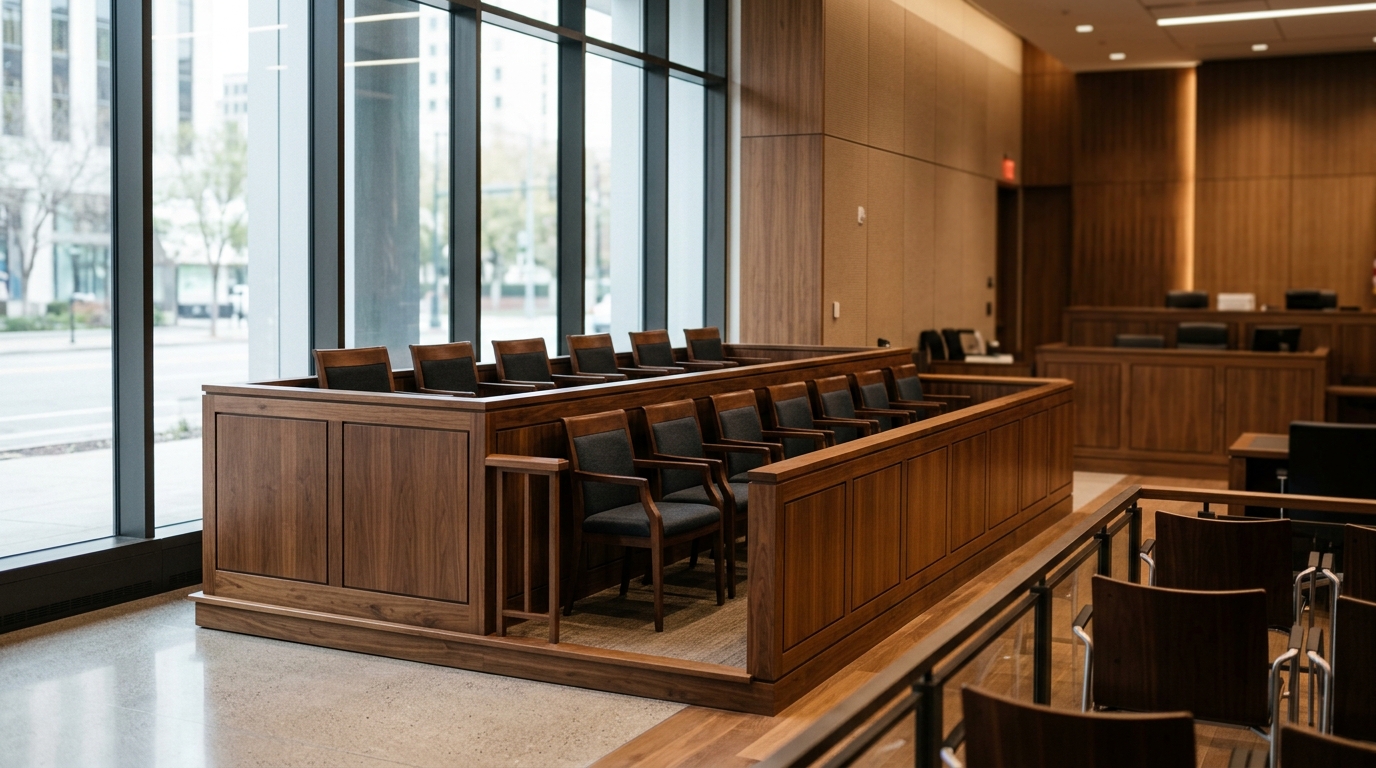
The jury you pick this year is drawn from a different pool than the one you picked from ten years ago. Not because the rules of who qualifies changed much, but because the raw material feeding the source lists moved, the counties feeding the biggest civil dockets grew unevenly, and — as of January 1, 2026 — the statute governing peremptory challenges in civil trials is no longer the one most working plaintiff lawyers learned on.
None of this is abstract. Venire composition drives damages ranges, comparative-fault instincts, and how a room reacts to a plaintiff who missed work versus one who could not return to it at all. If your voir dire questions and your peremptory strategy still assume the panel you saw before the pandemic, you are trying a case to a jury that no longer exists.
Where the names come from
California builds its jury pools from two combined source lists under Code of Civil Procedure section 197: registered voters and licensed drivers plus DMV identification-card holders. The statute directs courts to use both, de-duplicated, so that the master list reaches beyond the narrower slice of people who register to vote. That mechanical detail matters more than it sounds, because the two lists skew differently.
The DMV list expanded materially after California began issuing driver's licenses regardless of immigration status. The population appearing on the licensed-driver list is broader, younger on average, and more linguistically diverse than the voter roll alone. Because section 197 folds both lists together, the theoretical pool now captures residents who would never have surfaced through voter registration. Whether they actually appear in the box is a different question — summons response rates, hardship excusals under CCP section 204, and the six-month English-language and residency qualifications of section 203 all filter the theoretical pool down to the people who take the oath.
The practical takeaway: the gap between the master list and the seated panel is where jury composition is really decided, and that gap varies enormously by county.
Venue growth is not uniform
The counties carrying the heaviest personal-injury dockets have not grown at the same rate or in the same direction. Coastal metros have flattened or lost population while inland counties — Riverside, San Bernardino, parts of the Central Valley — absorbed the people leaving them. That migration reshaped the median juror in those venues: younger households, more first-generation homeowners, longer commutes, and a working population whose relationship to a serious injury is immediate rather than hypothetical.
For a plaintiff trying an auto or trucking case inland, that shift generally helps on liability comprehension — commuters understand following distance and merge geometry without an animation — while cutting against inflated general-damages numbers in venues where jurors run tight household budgets. The reverse pressure appears in coastal venues, where an older, more settled panel may be more comfortable with large numbers but more skeptical of soft-tissue claims. The old shorthand that pinned each county to a fixed verdict temperament is decaying because the underlying population moved. Treat every venue profile older than a few years as suspect.
This is the same reason a defendant's paper story about a driver or a route can flip a case, as it did in the clean-driving-record reversal we covered earlier this summer — the composition of the room that hears that story is doing half the work.
CCP section 231.7 now governs civil peremptories
Assembly Bill 3070 added Code of Civil Procedure section 231.7, which sets out a framework for objecting to peremptory challenges believed to rest on a juror's race, ethnicity, gender, religious affiliation, or the perceived proxies for those categories. The statute applied to criminal trials starting January 1, 2022, and — this is the part that catches practitioners off guard — it applies to civil trials for jury selection proceedings beginning on or after January 1, 2026.
Section 231.7 goes well past the older People v. Wheeler (1978) 22 Cal.3d 258 and Batson v. Kentucky (1986) 476 U.S. 79 analysis. It eliminates the requirement of a prima facie showing of purposeful discrimination, directs the court to evaluate the objection under a reasonable-person standard rather than hunting for subjective intent, and enumerates a list of reasons that are presumptively invalid — including a juror's prior negative experience with law enforcement, living in a high-crime neighborhood, and receipt of public assistance. It also flags certain conduct-based justifications, such as inattentiveness or demeanor, as objectionable unless corroborated on the record.
For plaintiff lawyers this cuts two ways. It constrains a defense bar that has historically used facially neutral reasons to thin panels of jurors thought sympathetic to injury claims. It also constrains you. The reflexive strike of a juror who seemed cold, distracted, or hostile now needs a stated reason that survives the section 231.7 list, and demeanor calls need something the reporter can capture. Build your record contemporaneously; a justification offered after the objection lands reads as pretext.
What this does to voir dire
A more heterogeneous pool combined with a narrower strike power means voir dire has to do work that peremptories used to do. Two adjustments matter.
Move causes for cause harder
With peremptories now riskier to spend and easier to challenge, cause challenges under CCP section 225(b) become the cleaner tool for removing genuinely unfavorable jurors. That means questioning designed to surface actual bias on the record — commitments a juror cannot honestly make, fixed views about lawsuits or damages — rather than banking on a silent strike later. A juror who says they cannot award money for pain they cannot see is a cause problem you can develop; a juror who merely gives you a bad feeling is now expensive to remove.
Ask about the injury economy, not just attitudes
In inland venues with younger, financially stretched panels, the operative bias is often not ideology but anchoring — jurors who cannot imagine the numbers because nothing in their own lives approaches them. Voir dire that walks the panel through the concept of lifetime cost, future care, and lost earning capacity does more than any strike. This is the same discipline that shows up in causation-heavy trials, where the doctrinal point and the human one have to land together, as in the Werner proximate-cause analysis we ran on the trucking side.
Data hygiene beats folklore
The single most common mistake is trying a 2026 case on a mentor's 2015 venue reputation. Pull the current picture yourself. Court demographic reports, the county's own summons-response data where available, and your own de-briefs after each trial are worth more than any regional stereotype. When you evaluate settlement posture against likely venire, weigh the composition you can document, not the one you remember.
The same care applies downstream of the verdict. A panel's willingness to award future-care numbers only matters if the recovery survives contact with liens and offsets — the reason we keep returning to mechanics like cutting a Medicare conditional payment before final demand. Jury composition sets the ceiling; execution decides what the client keeps.
The short version
The source lists widened, the population moved inland and younger, and the strike rules tightened. Each of those changes is modest on its own; together they mean the panel is more varied, harder to shape by peremptory, and less predictable from memory. The lawyers who win in front of these juries are the ones who re-scout every venue, develop cause challenges instead of relying on silent strikes, and build a clean section 231.7 record every time they raise the challenge card. Try the jury you have, not the one you used to get.