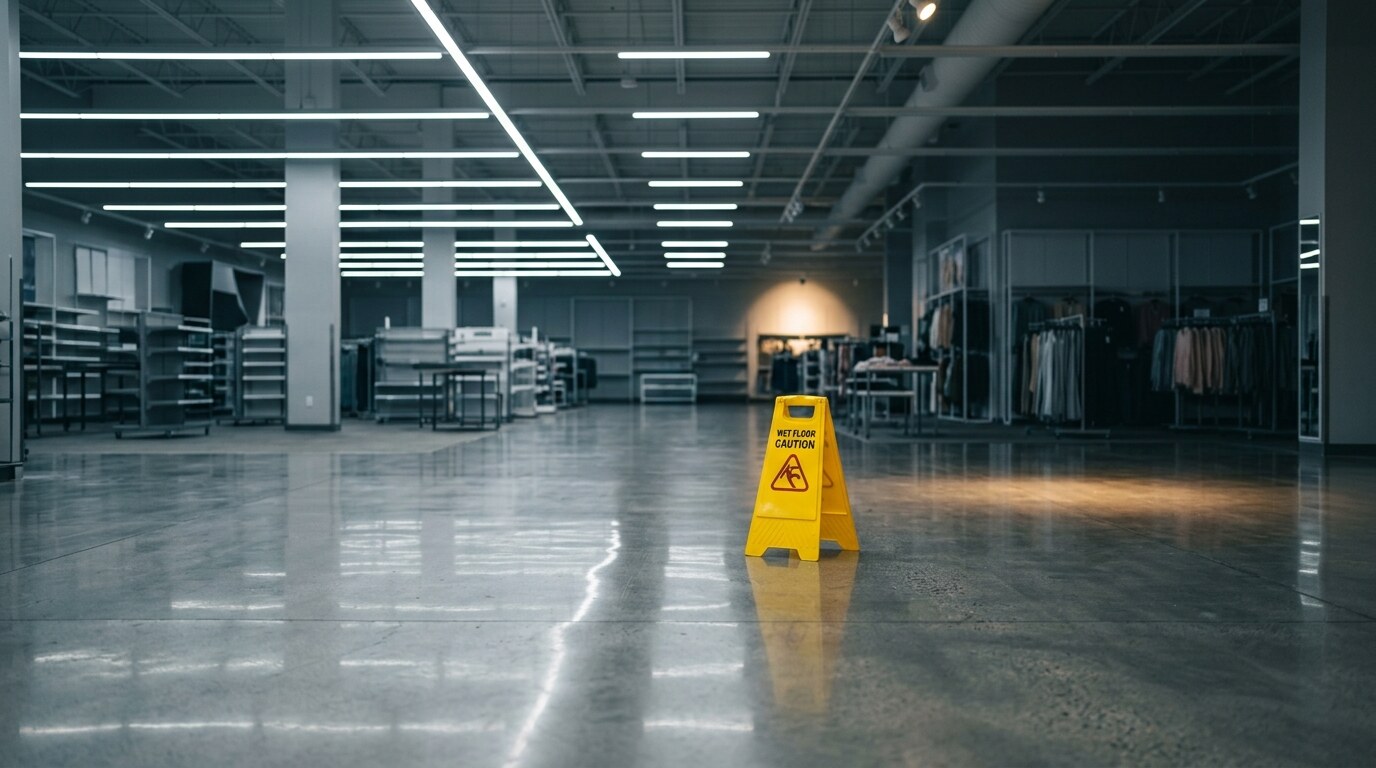
The summary-judgment fight in a premises case rarely turns on whether the floor was wet. It turns on whether the occupier knew, or should have known, that the hazard sat there long enough to fix it. Two recent threads in the case law, a strict Texas reaffirmation on duration and a line of New Jersey rulings policing the mode-of-operation doctrine, sharpen how plaintiff's counsel should build the notice record from the first intake call.
Duration still decides constructive notice
Almost every jurisdiction lets a plaintiff prove either actual or constructive notice of the dangerous condition. Constructive notice is where most cases live, and it reduces to one question: how long did the condition exist before the fall? Texas has policed that question since Wal-Mart Stores, Inc. v. Reece, which held that proximity to the hazard and how conspicuous it was do not substitute for temporal evidence. A 2026 Texas Supreme Court decision involving H-E-B reaffirmed the rule, rejecting an effort to fill the duration gap with proof of leaks elsewhere in the store and the chain's own inspection policies.
The takeaway is not that Texas is closed to plaintiffs. It is that a general housekeeping narrative will not raise a fact issue on its own. You need evidence that fixes the hazard in time: a half-melted product, dried edges on a spill, cart tracks or footprints through it, a timestamp on video, or an inspection log showing an employee walked the aisle clean twenty minutes earlier. Even in plaintiff-friendly states the defense playbook is identical, so the temporal record is worth building everywhere.
Mode of operation, and its limits
The mode-of-operation doctrine is the main route around the duration requirement. Where a business's self-service model makes spills or hazards reasonably foreseeable, some states relieve the plaintiff of proving notice for conditions tied to that operation. It is a powerful theory in the right setting, like a self-serve salad bar or a loose-produce display, but it is not a general exception that swallows the notice rule.
New Jersey has spent the last decade drawing those lines. In Prioleau v. Kentucky Fried Chicken, the state's high court confined the doctrine to the specific zones affected by self-service operations, not the whole premises. In Jeter v. Sam's Club, it declined to extend the rule where customers handled sealed containers of grapes rather than loose product, reasoning that the packaging removed the foreseeable-spill rationale. Counsel who want the inference need to tie the hazard directly to how customers, or employees stocking that operation, interact with the goods. Plead it as a fact-specific theory, not a label.
Preserve the evidence before it cycles out
The proof that wins a notice fight is perishable. Retail surveillance often overwrites on a thirty to ninety day loop, and incident-report systems purge or get buried in claims files. A preservation letter should go out the day you are retained, and it should be specific.
- All video covering the location for several hours before and after the fall, not just the clip of the incident itself, so you can prove how long the condition sat.
- Sweep logs, inspection sheets, and any electronic task-management records for the shift.
- The incident report, witness statements, and internal claims notes, which are often where an employee admits the spill had been reported.
- Staffing and scheduling records to test whether posted inspection intervals were actually met.
When a defendant cannot produce video that its own policy says existed, that gap is leverage. A well-documented spoliation argument can shift the inference on duration in your favor, sometimes turning a thin notice case into a triable one.
Anticipate open-and-obvious
The other half of the defense is open-and-obvious: the condition was so apparent that the occupier owed no duty to warn, or the plaintiff's own choice to encounter it controls. The doctrine has softened in many comparative-fault states, where obviousness goes to apportionment rather than a complete bar, but it still ends cases at summary judgment in others. Get ahead of it by documenting why an ordinary patron would not have seen or avoided the hazard: lighting, distraction by displays, the angle of approach, or a foreseeable reason the invitee had to cross the area anyway.
Practice takeaways
Premises cases are won in the first two weeks, not at trial. Treat the notice record as the spine of the file: send the preservation letter immediately, lock down the temporal evidence, and choose your theory, ordinary notice or mode of operation, based on the actual operation rather than a generic pleading. For more on premises practice, see our ongoing slip-and-fall coverage, and for the intake and case-selection mechanics behind a strong file, our practice-operations reporting. When the case resolves, the same evidence discipline pays off in lien and settlement accounting, where a clean liability record strengthens your reduction arguments.