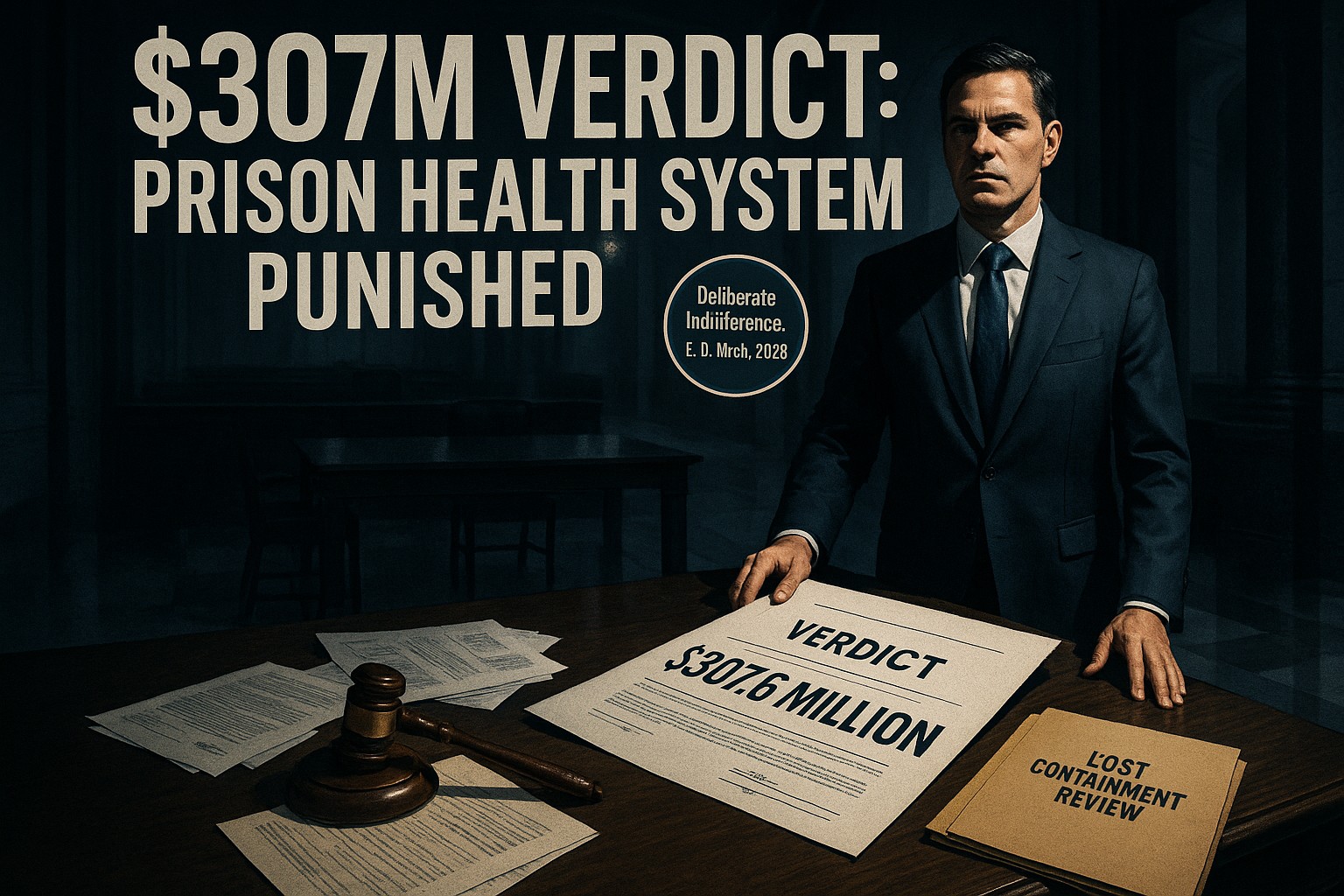
$307.6 Million Verdict Against Corizon Successor Sets Federal Healthcare-Negligence Benchmark
On April 2, 2026, a federal jury in the Eastern District of Michigan returned one of the largest healthcare-negligence verdicts in U.S. history in Jackson v. CHS TX Inc. (f/k/a Corizon Health), Case No. 2:19-cv-13382. The jury awarded Kohchise Jackson $7.5 million in compensatory damages and $300 million in punitive damages against CHS TX Inc., plus $100,000 in punitive damages against Dr. Keith Papendick individually for deliberate indifference. Total award: $307.6 million.
Jackson, a Michigan prisoner, required a colostomy-reversal surgery. CHS TX denied authorization for two years, and internal records introduced at trial showed the denials were driven by cost containment rather than clinical judgment. Jonathan F. Marko of Marko Law PLLC in Detroit served as lead trial counsel.
For plaintiff firms working correctional-healthcare cases or any institutional healthcare-negligence matter, the punitive ratio of approximately 40:1 against the corporate defendant signals jury tolerance for cost-cutting rationales that override physician recommendations. The deliberate-indifference standard, borrowed from Eighth Amendment doctrine, provided the foundation for both the corporate and individual punitive awards.
Firms pursuing institutional healthcare-negligence claims should document every internal cost-review communication that preceded a denial of care; those records are the punitive-damages foundation.
Three Additional 2026 Verdicts Define the Damages Spectrum
A Philadelphia jury awarded $35 million to a 45-year-old woman who underwent a full hysterectomy after being told she had advanced endometrial cancer, only to learn post-surgery that the cancer diagnosis was incorrect. Med-mal firms are actively citing the verdict in surgical misdiagnosis dockets as a reference point for damages framing where an irreversible procedure follows a false-positive pathology report.
In Sacramento County, a jury awarded $110 million to the family of a 100-year-old assisted living resident who wandered outside the facility and died of exposure. The jury found the facility negligent in both supervision protocols and elopement prevention. That verdict reinforces liability exposure for any residential care operator that documents elopement risk at intake but fails to implement corresponding physical safeguards.
In Mobile County, Alabama, a jury awarded $50 million to the family of Dan Haas, who died in December 2020 after his cardiologist discharged him despite a heart catheterization showing a life-threatening coronary blockage. The verdict, rendered in 2026, extends the discharge-decision liability line: when objective diagnostic data contradicts the clinical choice to release, the record itself becomes the negligence predicate.
Across all three verdicts, the common liability thread is a documented clinical or institutional record that directly contradicted the decision made; plaintiff firms should request all pre-decision internal communications in any case involving a discharge or treatment-denial.
Boston Scientific Infinion CX Class I Recall: 1,081 Injuries and an Expanding SCS Docket
The FDA announced a Class I recall of the Boston Scientific Infinion CX Spinal Cord Stimulator Lead in September 2026, linking 1,081 serious injuries to lead fractures at anchor sites. Approximately 1,079 unused leads are subject to the recall. The recall notice does not require removal of already-implanted leads.
That carve-out creates a distinct litigation posture. Clients with implanted Infinion CX leads remain at risk for the fracture mechanism but fall outside the recall's removal directive, which creates both a continuing-injury monitoring obligation and a litigation pathway separate from the recall itself. Abbott's Proclaim SCS system has separately accumulated FDA complaint activity for unintended painful stimulation, device shutdowns, and therapy failures. Plaintiff firms are using the Proclaim complaint history as affirmative evidence of design-defect knowledge in suits against both manufacturers.
Telehealth is emerging as a parallel liability theory in this docket. Post-implant remote monitoring of SCS devices is now standard practice at many pain-management centers, and that monitoring is being scrutinized for negligence where protocols failed to flag a lead-fracture signal before the patient presented in crisis. Pre-authorization denials for SCS implantation handled through telehealth-based utilization review are drawing similar attention from plaintiff experts.
Firms with active SCS clients should determine whether those clients hold implanted Infinion CX leads and whether the treating facility maintained a documented remote-monitoring protocol; gaps in either area are the current focus of expert analysis in pending litigation.
California Supreme Court Dismisses 23,000 Gilead TDF Cases
On August 4, 2026, the California Supreme Court ruled 6-1, dismissing approximately 23,000 consolidated HIV/TDF drug-injury cases against Gilead Sciences. The court held that Gilead owed no duty of negligence to accelerate the commercialization of a safer tenofovir formulation. Justice Evans dissented.
The ruling eliminates a significant tranche of the pending California medical product-liability docket. The court's framing declines to impose an affirmative duty to develop and commercialize a safer alternative product, a holding that defense counsel will cite in any California failure-to-develop theory involving pharmaceuticals, implantable devices, or medical software.
Justice Evans' dissent signals that the duty question remains contested at the court's highest level, and federal Ninth Circuit litigation under separate theories is not foreclosed by the ruling. California firms holding TDF referral arrangements should evaluate whether any federal claim distinct from the dismissed state theory remains viable.
The 6-1 dismissal removes California as the dominant venue for TDF claims, but plaintiff firms with a viable federal theory should treat the state ruling as a venue-mapping signal rather than a global resolution of the docket.
ERISA Lien Reduction and Medicare Secondary Payer: Closing-Condition Essentials
ERISA preempts state anti-subrogation statutes, so ERISA plan lien demands cannot be reduced under state law regardless of how favorable a state's made-whole or anti-subrogation provisions may be. That ceiling does not mean plan demands are paid in full. Common-fund doctrine arguments, structured around the attorney-fee and litigation-cost savings the plan receives from counsel's work, continue to yield reductions of 30 to 40 percent on pre-common-fund demand figures.
The post-Montanile v. Board of Trustees (U.S. 2016) reimbursement framework governs when ERISA plan equitable relief is available: if settlement funds have been dissipated and no longer exist as an identifiable fund in the plaintiff's possession, ERISA Section 502(a)(3) relief is unavailable to the plan. That distinction is most relevant where settlement proceeds are partially distributed before the plan's demand is resolved, a sequencing risk that settlement-disbursement procedures should address explicitly.
Medicare Secondary Payer resolution remains a closing-condition prerequisite in all federal-court PI settlements. Conditional payment letters from CMS should be requested early and any dispute of individual line items initiated before settlement approval; post-approval dispute timelines are compressed and the administrative record is harder to supplement after the fact.
For medical providers assessing lien-resolution services, the ERISA common-fund reduction range of 30 to 40 percent on pre-fund demands is the current realistic negotiation benchmark when counsel has created a substantial common fund.
Operations: Provider Lien Structures and the Institutional Liability Record
The University of California Board of Regents settled for $11.6 million with an electrician who lost his leg following routine knee surgery at UC Irvine Medical Center. For providers and plaintiff counsel alike, the California public-hospital settlement illustrates a layered dynamic: when the defendant is a public entity, sovereign-immunity considerations, Government Claims Act procedures, and public-lien frameworks all intersect with standard hospital-lien negotiation. Providers whose liens are subject to negotiation should confirm that their lien agreements specify the governing statute and address common-fund contribution expressly.
The $110 million Sacramento elopement verdict is a direct reference point for residential care operators. Any documented risk assessment in a resident's file that predates an elopement incident will be used both to establish notice and to support punitive exposure. Risk documentation that identifies a hazard without a corresponding intervention order is a recurring liability pattern in residential-care defense; operators should review whether their intake and care-planning procedures close that loop before an incident occurs.
For providers evaluating the LawyersTrend directory as a case-referral channel, the 2026 verdict data signals continued case volume in three areas: post-surgical complication claims, SCS device-related injury claims, and institutional supervision failures. Each category carries distinct lien-recovery mechanics that affect net provider reimbursement at settlement.
As of Q3 2026, the four major institutional-negligence verdicts covered in this article range from $35 million to $307.6 million, and in three of the four cases the liability theory centered on a documented institutional record that identified a risk but generated no corresponding corrective action.